Quick Recipe Version (TL;DR)
Quick Ingredients
- 3 cups (360 g) all-purpose flour
- 2 1/2 tsp baking powder, 1/2 tsp baking soda, 1 tsp fine salt
- 1 3/4 cups (350 g) granulated sugar
- 3/4 cup (170 g) unsalted butter, room temperature, plus more for pans
- 1/4 cup (60 ml) neutral oil
- 4 large eggs, room temperature
- 1 1/4 cups (300 ml) whole milk, room temperature
- 1 tbsp finely grated lemon zest + 2 tbsp lemon juice
- 2–3 tsp dried culinary lavender, divided
- 3 cups (450 g) fresh or frozen blackberries, plus extra for decorating
- 1 tbsp cornstarch + 1 tbsp water
- 1/2 cup (120 ml) water + 1/2 cup (100 g) sugar (for syrup)
- 1 1/2 cups (340 g) unsalted butter, room temperature (for buttercream)
- 5 cups (600 g) powdered sugar
- 4–6 tbsp heavy cream
- 2 tsp vanilla extract
- Purple and/or pink gel food coloring (tiny amount)
- Edible flowers (like violas or pansies), optional
Do This
- 1. Gently warm the milk and heavy cream separately with dried lavender, let steep 15–20 minutes, then strain and cool completely.
- 2. Simmer blackberries, sugar, lemon juice, and cornstarch slurry until thick and jammy; cool to room temperature.
- 3. Make cake batter: cream butter, oil, and sugar; beat in eggs, lemon zest, and vanilla; alternate adding dry ingredients and lavender milk. Divide into three greased and lined 8-inch pans.
- 4. Bake at 350°F (175°C) for 22–26 minutes, until golden and a toothpick comes out clean. Cool completely and level tops if needed.
- 5. Boil water, sugar, and a pinch of lavender for 3–4 minutes for syrup; steep, strain, and cool. Make lavender buttercream by beating butter, powdered sugar, lavender cream, vanilla, salt, and a hint of purple coloring until fluffy.
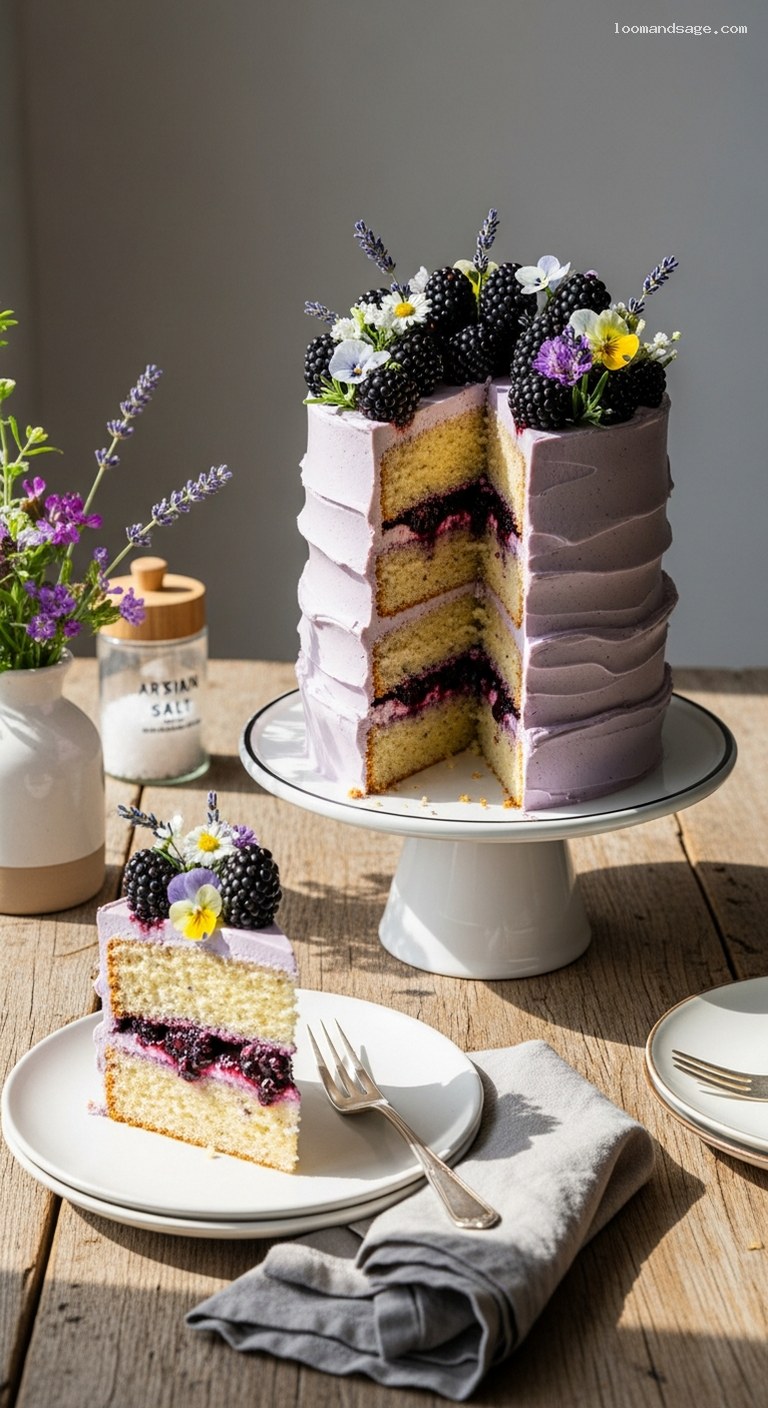
- 6. Brush cake layers with lavender syrup, stack with a ring of buttercream and a layer of blackberry compote between each, then frost the outside with pale purple buttercream. Decorate with fresh blackberries and edible flowers.
Why You’ll Love This Recipe
- Delicate floral notes from real culinary lavender pair beautifully with bright lemon and juicy blackberries.
- Blackberry compote and lavender buttercream create gorgeous layers and a sophisticated flavor profile.
- Soft pastel purple frosting, glossy berries, and edible flowers make this a true celebration centerpiece.
- Home-cook friendly: no fancy equipment required, but the result looks like a high-end bakery cake.
Grocery List
- Produce: Fresh blackberries, lemons, optional edible flowers (like violas, pansies, or lavender sprigs).
- Dairy: Unsalted butter, whole milk, heavy cream, eggs.
- Pantry: All-purpose flour, granulated sugar, powdered sugar, baking powder, baking soda, fine salt, neutral oil (canola or sunflower), cornstarch, dried culinary lavender, vanilla extract, purple/pink gel food coloring (optional).
Full Ingredients
For the Lemon Lavender Cake Layers (3 x 8-inch rounds)
- 3 cups (360 g) all-purpose flour
- 2 1/2 tsp baking powder
- 1/2 tsp baking soda
- 1 tsp fine sea salt
- 1 3/4 cups (350 g) granulated sugar
- 3/4 cup (170 g) unsalted butter, softened to room temperature
- 1/4 cup (60 ml) neutral oil (canola, vegetable, or sunflower)
- 4 large eggs, at room temperature
- 1 tbsp finely grated lemon zest (from about 1 large lemon)
- 2 tsp pure vanilla extract
- 1 1/4 cups (300 ml) whole milk
- 1 1/2–2 tsp dried culinary lavender, lightly crushed (for infusing the milk)
- Butter or nonstick spray, plus parchment rounds, for the pans
For the Blackberry Compote Filling
- 3 cups (450 g) blackberries, fresh or frozen
- 1/2 cup (100 g) granulated sugar
- 2 tbsp freshly squeezed lemon juice
- 1 tsp finely grated lemon zest (optional, for extra brightness)
- 1 tbsp cornstarch
- 1 tbsp cold water
- Pinch of salt
For the Lavender Syrup (for brushing layers – optional but recommended)
- 1/2 cup (120 ml) water
- 1/2 cup (100 g) granulated sugar
- 1/2–1 tsp dried culinary lavender
For the Lavender Buttercream Frosting
- 1 1/2 cups (340 g) unsalted butter, softened to room temperature
- 5 cups (600 g) powdered sugar, sifted
- 4–6 tbsp heavy cream
- 1 tsp dried culinary lavender (for infusing the cream)
- 2 tsp pure vanilla extract
- 1/4 tsp fine sea salt (or to taste)
- 1–2 drops purple gel food coloring, plus a tiny touch of pink if needed (optional, for a soft lavender hue)
For Decorating
- 1–1 1/2 cups fresh blackberries
- Small edible flowers (such as violas, pansies, or unsprayed herb blossoms)
- Optional: a few tiny fresh lavender sprigs (from culinary lavender), for garnish only
Step-by-Step Instructions
Step 1: Infuse the lavender and prepare your pans
Set yourself up for smooth baking. Lightly crush 1 1/2–2 teaspoons of dried culinary lavender between your fingers or with a mortar and pestle to release the aroma (do not pulverize; you want it in small pieces). In a small saucepan, gently warm the 1 1/4 cups (300 ml) milk until just steaming, not boiling. Stir in the crushed lavender, cover, and let steep for 15–20 minutes off the heat. After steeping, strain the milk through a fine mesh sieve into a measuring jug, pressing lightly on the lavender to extract flavor. Cool to room temperature before using.
While the milk infuses, preheat your oven to 350°F (175°C). Grease three 8-inch (20 cm) round cake pans with butter or nonstick spray. Line the bottoms with parchment rounds and lightly grease the parchment as well. This helps the delicate layers release cleanly.
Step 2: Make the blackberry compote filling
In a medium saucepan, combine 3 cups (450 g) blackberries, 1/2 cup (100 g) sugar, 2 tablespoons lemon juice, 1 teaspoon lemon zest (if using), and a pinch of salt. Place over medium heat and cook, stirring occasionally, until the berries release their juices and begin to break down, 5–7 minutes.
In a small bowl, stir together 1 tablespoon cornstarch and 1 tablespoon cold water to make a smooth slurry. Stir this into the bubbling berries. Continue to cook, stirring often, until the mixture thickens to a jammy texture that leaves a trail when you drag a spoon across the bottom of the pan, another 2–4 minutes. It will thicken more as it cools.
Remove from the heat and transfer the compote to a shallow bowl. Let it cool to room temperature, then refrigerate to chill completely before assembling the cake. A cool, thick filling helps keep the layers stable.
Step 3: Mix the lemon-lavender cake batter
In a medium bowl, whisk together the dry ingredients: 3 cups (360 g) all-purpose flour, 2 1/2 teaspoons baking powder, 1/2 teaspoon baking soda, and 1 teaspoon fine salt. Set aside.
In a large mixing bowl (or the bowl of a stand mixer fitted with the paddle), beat 3/4 cup (170 g) softened butter, 1/4 cup (60 ml) neutral oil, and 1 3/4 cups (350 g) sugar on medium speed until pale and fluffy, about 3–4 minutes. Scrape down the sides of the bowl once or twice.
Add the 4 eggs one at a time, beating well after each addition until fully incorporated. Mix in 1 tablespoon finely grated lemon zest and 2 teaspoons vanilla extract.
With the mixer on low, add the dry ingredients in three additions, alternating with the cooled lavender-infused milk in two additions (start and end with dry ingredients). Mix just until combined after each addition; do not overmix. If needed, finish folding gently by hand with a spatula to ensure there are no flour pockets. The batter will be fairly thick and creamy.
Step 4: Bake and cool the cake layers
Divide the batter evenly among the three prepared 8-inch pans (about 2 1/2–3 cups of batter per pan). Smooth the tops with an offset spatula or the back of a spoon so they bake level.
Bake at 350°F (175°C) for 22–26 minutes, or until the cakes are lightly golden, spring back when gently touched in the center, and a toothpick inserted in the middle comes out clean or with a few moist crumbs (no wet batter).
Cool the cakes in the pans on wire racks for 10–15 minutes, then carefully run a knife around the edges and turn them out onto the racks. Peel off the parchment and let the layers cool completely, at least 45 minutes. For the cleanest decorating, you can wrap the cooled layers in plastic wrap and chill them in the fridge for 30–60 minutes before assembly.
Step 5: Make the lavender syrup and buttercream
For the syrup, combine 1/2 cup (120 ml) water, 1/2 cup (100 g) sugar, and 1/2–1 teaspoon dried lavender in a small saucepan. Bring to a gentle boil over medium heat, stirring to dissolve the sugar. Boil for 2–3 minutes, then remove from heat, cover, and let steep 10–15 minutes. Strain out the lavender and cool completely. This syrup keeps the cake moist and adds a delicate floral note.
For the buttercream, first infuse the cream: gently warm 4–6 tablespoons heavy cream with 1 teaspoon dried lavender in a small pan until just steaming. Remove from heat, cover, and steep 15 minutes. Strain and cool completely; you want the cream to be at least room temperature but not hot when adding to the frosting.
In a large bowl or stand mixer, beat 1 1/2 cups (340 g) softened butter on medium-high speed until very light and creamy, 3–4 minutes. Gradually add 5 cups (600 g) sifted powdered sugar, about 1 cup at a time, mixing on low to combine and then on medium to fluff, scraping the bowl as needed.
Add 2 teaspoons vanilla, 1/4 teaspoon salt, and 3–4 tablespoons of the lavender-infused cream. Beat on medium-high for 2–3 minutes until smooth, fluffy, and spreadable. Add more cream a teaspoon at a time if needed to reach a soft but pipeable consistency. For the signature pale lavender hue, beat in 1–2 drops of purple gel food coloring (and a tiny touch of pink, if desired) until you have a soft, light purple buttercream.
Step 6: Level, fill, and stack the cake layers
If your cake layers have domed tops, use a long serrated knife to gently trim them so they are flat. Save the scraps for snacking or crumbling over ice cream.
Place a small dab of buttercream in the center of your cake stand or serving plate to “glue” the first layer down. Set the first cake layer on top, cut side up.
Using a pastry brush or spoon, lightly brush the top of the layer with some lavender syrup. Do not soak it; you just want a light, even coating.
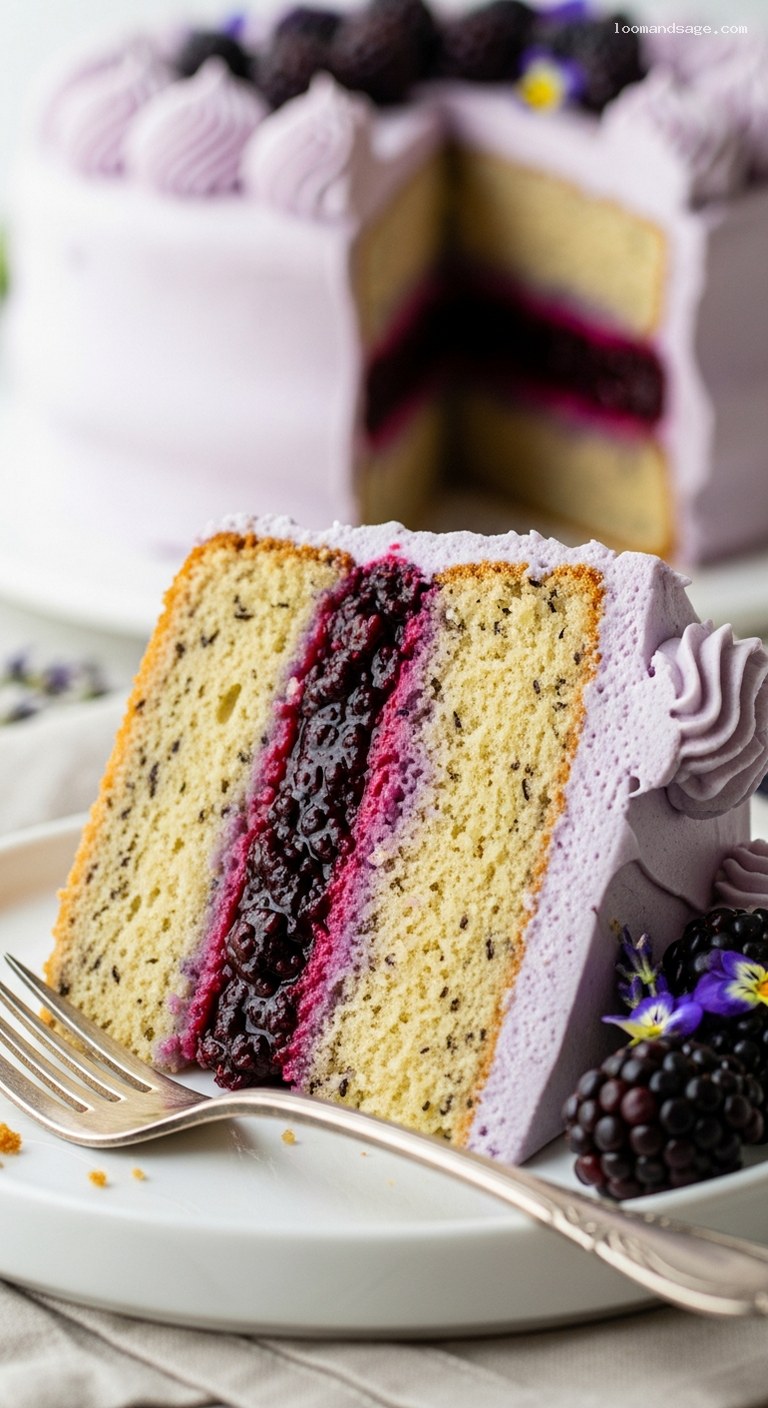
Spread a thin layer of buttercream (about 1/2 cup) over the cake, pushing it just to the edges. Then pipe a ring of buttercream around the outer edge of the layer to create a dam that will hold the compote. Spoon 1/3–1/2 cup of the cooled blackberry compote inside the ring and spread gently into an even layer. Avoid getting compote on the outer edges so it does not bleed into the frosting.
Top with the second cake layer, repeat with syrup, buttercream, and compote, then finish with the third layer, cut side down to give a flat top. Press gently to level.
Step 7: Frost, decorate, and chill
Apply a thin “crumb coat” of buttercream over the entire cake: spread a very thin layer on the top and sides to trap any loose crumbs and blackberry streaks. Chill the cake for 15–20 minutes to set this coat.
Once the crumb coat is firm, apply a more generous layer of the pale lavender buttercream over the top and sides. Use an offset spatula or bench scraper to smooth the sides for a sleek look, or create soft swoops and swirls for a more rustic, romantic finish.
Decorate the top with clusters of fresh blackberries, tucking them slightly into the buttercream so they feel anchored. Nestle a few edible flowers among the berries, and, if desired, add a couple of tiny fresh lavender sprigs for a hint of what is inside (remind guests to set these aside before eating if the stalks are woody).
Chill the finished cake for at least 30 minutes before slicing to help the layers set and make cleaner cuts. Serve slightly cool or at cool room temperature so the buttercream is silky and the lavender aroma shines.
Pro Tips
- Use culinary lavender only. Make sure the lavender is labeled “culinary” or “food grade.” Other lavender (like potpourri) can be bitter or treated with chemicals.
- Go easy on the lavender. Lavender should be a gentle background note, not overpowering. If you are sensitive to floral flavors, start at the lower end of the suggested amounts.
- Cool fillings thoroughly. Warm blackberry compote or syrupy layers will make your buttercream slide and the cake unstable. Make sure everything is cool before assembly.
- Chill for neater slices. A short chill in the fridge firms the buttercream and compote so the layers hold together beautifully when cut.
- Level and measure for even layers. Weigh the batter into each pan or use a measuring cup to divide it evenly. Leveling domes gives the cake a professional, straight-sided look.
Variations
- Vanilla-lavender version: Skip the lemon zest and juice. Add an extra 1 teaspoon vanilla to the batter and 1/2 teaspoon to the buttercream for a pure vanilla-lavender profile.
- Two-layer 9-inch cake: Bake the batter in two 9-inch (23 cm) round pans for 25–30 minutes. You will have slightly thicker layers; adjust filling amounts so they are not overfilled.
- Mixed berry twist: Replace up to half of the blackberries in the compote and decoration with raspberries or blueberries for a more complex berry flavor and color palette.
Storage & Make-Ahead
The fully assembled cake will keep, covered, in the refrigerator for up to 3 days. For the best texture, let slices sit at room temperature for 20–30 minutes before serving so the buttercream softens slightly.
You can make the cake layers up to 2 days in advance: once cooled, wrap each layer tightly in plastic wrap and store at room temperature or refrigerate. The blackberry compote can be made 3–4 days ahead and refrigerated in an airtight container. The lavender syrup keeps for about 1 week in the fridge.
The buttercream can be prepared up to 2 days ahead. Store in an airtight container in the fridge, then bring to room temperature and re-whip with a splash of extra cream if needed before frosting the cake.
For longer storage, unfrosted cake layers can be wrapped well and frozen for up to 2 months. Thaw overnight in the refrigerator before assembling.
Nutrition (per serving)
Approximate values for 1 of 12 slices: about 780 calories; 12–14 g protein; 95–100 g carbohydrates; 40–45 g fat; 2–3 g fiber. Actual values will vary based on exact ingredients, decorating amounts, and portion sizes.