
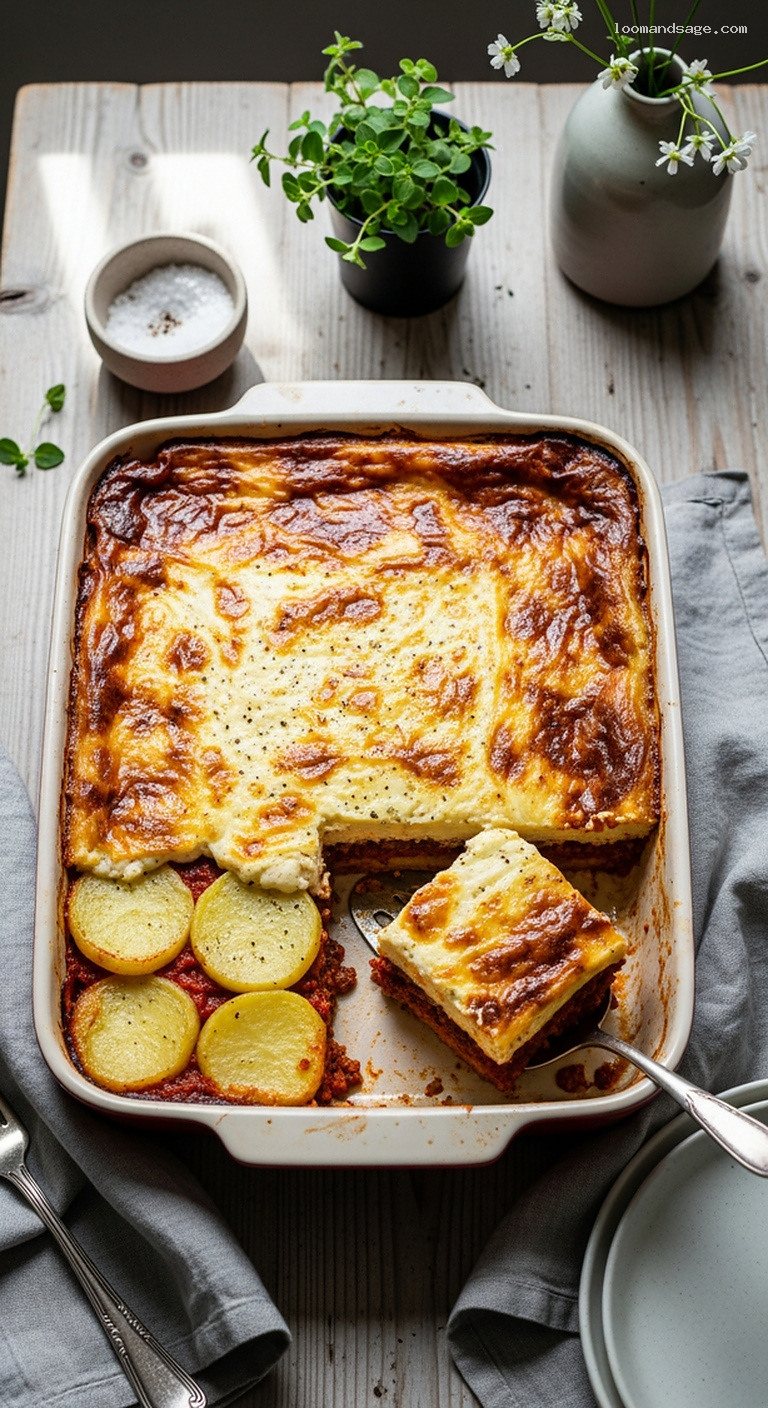
Quick Recipe Version (TL;DR)
Quick Ingredients
- 2 large eggplants (about 2 lb / 900 g total), sliced 1/4 inch thick
- 3 medium russet potatoes (about 1 lb / 450 g), sliced 1/4 inch thick
- 1/2 cup (120 ml) olive oil, plus more as needed for frying/brushing
- 1 1/2 lb (680 g) ground lamb or beef
- 1 large onion, finely chopped
- 4 cloves garlic, minced
- 1/2 cup (120 ml) dry red wine
- 1 can (14.5 oz / 400 g) crushed tomatoes
- 2 tbsp tomato paste
- 1 tsp ground cinnamon + 1/2 tsp ground allspice
- 1/4 tsp ground cloves (optional), 1 tsp dried oregano
- Salt and black pepper
- 5 tbsp (70 g) unsalted butter
- 6 tbsp (45 g) all-purpose flour
- 4 cups (1 L) whole milk, warmed
- 1/4 tsp ground nutmeg
- 3 large eggs, at room temperature
- 1 cup (90 g) grated Parmesan or Kefalotyri cheese, divided
Do This
- 1. Salt eggplant slices 30 minutes, then pat dry. Fry or lightly oil and roast eggplant and potato slices until tender and golden.
- 2. For meat sauce, sauté onion and garlic in olive oil, brown ground lamb or beef, then add wine, tomatoes, tomato paste, spices, salt, and pepper; simmer until thick, about 25–30 minutes.
- 3. For béchamel, melt butter, whisk in flour 2 minutes, then gradually whisk in warm milk. Cook, whisking, until thick, then season with salt, pepper, and nutmeg. Cool 5 minutes, then whisk in beaten eggs and half the cheese.
- 4. Heat oven to 375°F (190°C). Oil a 9×13 inch (23×33 cm) baking dish. Layer potatoes on the bottom, then half the eggplant.
- 5. Spread all the meat sauce over the eggplant. Top with remaining eggplant slices.
- 6. Pour béchamel over the top, smoothing evenly, and sprinkle with remaining cheese.
- 7. Bake 35–40 minutes until deep golden and bubbling. Rest at least 20 minutes before slicing and serving.
Why You’ll Love This Recipe
- Classic Greek comfort food: layers of tender eggplant, soft potatoes, spiced meat, and velvety béchamel.
- Warm flavors of cinnamon, allspice, and red wine make it feel special enough for a dinner party centerpiece.
- Makes a generous pan that reheats beautifully, so it is perfect for leftovers or meal prep.
- Step-by-step guidance so even first-timers can tackle this “special occasion” dish with confidence.
Grocery List
- Produce: Eggplants, russet potatoes, onion, garlic
- Dairy: Unsalted butter, whole milk, eggs, grated Parmesan or Kefalotyri cheese
- Pantry: Olive oil, dry red wine, crushed tomatoes, tomato paste, all-purpose flour, ground cinnamon, ground allspice, ground cloves, ground nutmeg, dried oregano, salt, black pepper
Full Ingredients
For the Eggplant & Potatoes
- 2 large eggplants (about 2 lb / 900 g total), cut into 1/4 inch (6 mm) thick lengthwise slices
- 3 medium russet potatoes (about 1 lb / 450 g), peeled and cut into 1/4 inch (6 mm) thick rounds
- 1/2 cup (120 ml) olive oil, plus more as needed for frying or brushing
- Salt, for salting eggplant and seasoning layers
- Freshly ground black pepper, to taste
For the Spiced Meat Sauce
- 2 tbsp olive oil
- 1 large yellow onion, finely chopped
- 4 cloves garlic, minced
- 1 1/2 lb (680 g) ground lamb or ground beef
- 1/2 cup (120 ml) dry red wine
- 1 can (14.5 oz / 400 g) crushed tomatoes
- 2 tbsp tomato paste
- 1 tsp dried oregano
- 1 tsp ground cinnamon
- 1/2 tsp ground allspice
- 1/4 tsp ground cloves (optional, but traditional and very aromatic)
- 1 1/4 tsp fine sea salt, or to taste
- 1/2 tsp freshly ground black pepper, or to taste
- 1 bay leaf (optional)
For the Béchamel Topping
- 5 tbsp (70 g) unsalted butter
- 6 tbsp (45 g) all-purpose flour
- 4 cups (1 L) whole milk, gently warmed
- 1 1/4 tsp fine sea salt, or to taste
- 1/2 tsp freshly ground black pepper
- 1/4 tsp ground nutmeg
- 3 large eggs, at room temperature
- 1 cup (90 g) finely grated Parmesan, Kefalotyri, or Pecorino Romano cheese, divided (1/2 cup for béchamel, 1/2 cup for sprinkling on top)
For Assembling & Finishing
- Olive oil, for greasing the baking dish
- Extra grated cheese, for finishing (optional)
- Fresh parsley or oregano leaves, chopped, for garnish (optional)
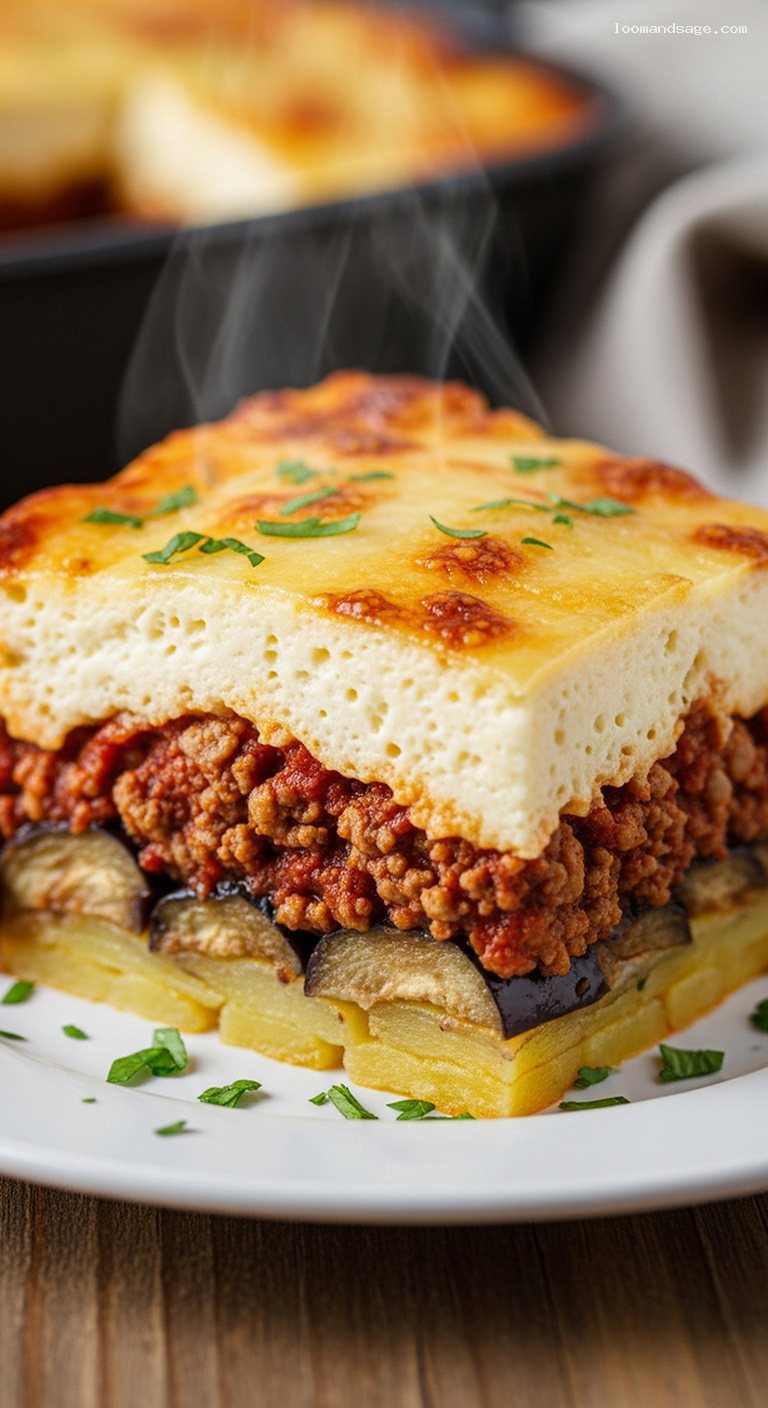
Step-by-Step Instructions
Step 1: Prepare and Pre-cook the Eggplant and Potatoes
Slice the eggplants lengthwise into 1/4 inch (6 mm) thick slices. Lay them in a single layer on baking sheets or large trays and sprinkle both sides generously with salt. Let them sit for 30 minutes; this draws out bitterness and some moisture. Meanwhile, peel and slice the potatoes into 1/4 inch (6 mm) rounds. Rinse the salted eggplant slices under cool water and pat them very dry with paper towels.
You can either fry or roast the vegetables. For frying, heat a thin layer of olive oil in a large skillet over medium-high heat. Fry eggplant slices in batches until golden on both sides and tender, about 2–3 minutes per side. Drain on paper towels. Repeat with potato slices, adding oil as needed. For a lighter version, brush both sides of the eggplant and potatoes with olive oil, arrange in single layers on baking sheets, and roast at 425°F (220°C) for 15–20 minutes, flipping once, until tender and lightly browned. Set aside to cool slightly.
Step 2: Make the Spiced Meat Sauce
In a large skillet or wide saucepan, heat 2 tbsp olive oil over medium heat. Add the chopped onion and cook, stirring occasionally, until soft and translucent, about 5–7 minutes. Add the minced garlic and cook for 30 seconds, just until fragrant.
Add the ground lamb or beef. Cook, breaking it up with a spoon, until well browned and no longer pink, about 7–8 minutes. If there is a lot of excess fat, spoon some off. Pour in the red wine and stir, scraping up any browned bits from the bottom of the pan. Let it simmer for 2–3 minutes to reduce slightly.
Stir in the crushed tomatoes, tomato paste, oregano, cinnamon, allspice, cloves (if using), bay leaf, salt, and black pepper. Reduce the heat to low and simmer gently, uncovered, for 20–25 minutes, stirring occasionally, until thickened and rich. Taste and adjust seasoning with more salt or pepper if needed. Remove the bay leaf and set the sauce aside to cool slightly while you make the béchamel.
Step 3: Prepare the Creamy Béchamel Sauce
In a medium saucepan, melt the butter over medium heat. When it is fully melted and foamy, whisk in the flour. Cook, whisking constantly, for 1–2 minutes to form a smooth paste (roux); it should bubble slightly but not brown. Gradually pour in the warm milk, a little at a time, whisking constantly to avoid lumps. Continue adding milk and whisking until all the milk is incorporated and the mixture is smooth.
Bring the sauce to a gentle simmer, still over medium heat, whisking often. Cook for 5–7 minutes, until thick enough to coat the back of a spoon. Remove from heat and season with salt, pepper, and nutmeg. Let the sauce cool for 5 minutes; this step helps prevent the eggs from scrambling when added.
In a separate bowl, lightly beat the eggs. Slowly whisk about 1 cup (240 ml) of the warm béchamel into the eggs to temper them, then pour the egg mixture back into the pot, whisking constantly until fully combined. Stir in 1/2 cup (45 g) of the grated cheese until melted and smooth. Set the béchamel aside; it should be thick, glossy, and pourable.
Step 4: Preheat the Oven and Prepare the Baking Dish
Preheat your oven to 375°F (190°C) with a rack in the center position. Lightly grease a 9×13 inch (23×33 cm) baking dish (or similar 3-quart / 3-liter casserole) with olive oil. This helps prevent sticking and makes serving easier. If your roasted or fried vegetables have released any excess oil, gently blot them with paper towels so the final dish is rich but not greasy.
Step 5: Layer the Potatoes, Eggplant, and Meat Sauce
Arrange the potato slices in a single, slightly overlapping layer on the bottom of the prepared baking dish. Season lightly with salt and pepper. Next, arrange about half of the eggplant slices over the potatoes, again slightly overlapping to cover the surface. If you have some smaller or irregular pieces, use them here to create a solid layer.
Spoon all of the meat sauce over this eggplant layer. Spread it out evenly with a spatula, pressing gently into the gaps so that there are no big empty spaces. Top the meat sauce with the remaining eggplant slices, creating another even, slightly overlapping layer. This creates defined layers so the moussaka slices beautifully after baking.
Step 6: Add the Béchamel and Bake Until Golden
Give the béchamel a quick stir to re-smooth it if needed. Pour it evenly over the top eggplant layer, using a spatula to spread it all the way to the edges. The béchamel should form a thick blanket over the entire surface. Sprinkle the remaining 1/2 cup (45 g) grated cheese evenly over the top.
Place the dish on a rimmed baking sheet to catch any potential drips. Bake in the preheated 375°F (190°C) oven for 35–40 minutes, or until the top is set, deeply golden, and bubbling around the edges. If you would like extra browning, you can switch to broil for the last 1–2 minutes, watching carefully so it does not burn.
Step 7: Rest, Slice, and Serve
Remove the moussaka from the oven and let it rest on a cooling rack for at least 20–30 minutes before slicing. This resting time is crucial: it allows the layers to set so that each portion holds together beautifully instead of collapsing on the plate.
Just before serving, sprinkle with a little extra grated cheese or chopped fresh parsley or oregano, if desired. Cut into squares or rectangles with a sharp knife, using a spatula to lift each portion out of the dish. Serve warm as the centerpiece of your meal, alongside a simple green salad and crusty bread if you like.
Pro Tips
- Salt the eggplant properly: The 30-minute salting step really improves both flavor and texture by reducing bitterness and excess moisture.
- Thicken the meat sauce: Let the sauce simmer until it is quite thick; a watery sauce will make the layers slide and the casserole soggy.
- Temper the eggs for smooth béchamel: Do not skip cooling the sauce slightly and whisking in a bit of béchamel to the eggs first; this keeps the topping creamy and custardy instead of scrambled.
- Let it rest: Just like lasagna, moussaka cuts much more neatly after it has cooled slightly. Aim for at least 20 minutes of resting time.
- Make it lighter: Roast the eggplant and potatoes instead of frying for less oil and an easier clean-up.
Variations
- All-eggplant version: Skip the potatoes and use 3 large eggplants instead, for a gluten-free-friendly (if you use gluten-free flour) and slightly lighter dish.
- Beef instead of lamb: Use ground beef for a more familiar flavor; a mix of half beef and half lamb is also excellent.
- Vegetarian moussaka: Replace the meat with 2 cups (about 400 g) cooked lentils and 8 oz (225 g) finely chopped mushrooms sautéed until browned. Keep the same tomato, wine, and spice mixture for a hearty, meatless version.
Storage & Make-Ahead
Let leftovers cool completely, then cover the dish tightly or transfer portions to airtight containers. Refrigerate for up to 4 days. Reheat individual servings in the microwave or warm the whole dish in a 325°F (165°C) oven, covered with foil, for 20–25 minutes or until heated through. Moussaka also freezes well: cool completely, wrap tightly in plastic and then foil, and freeze for up to 2 months. Thaw overnight in the refrigerator before reheating. For make-ahead prep, you can assemble the entire dish up to the baking step, cover, and refrigerate for up to 24 hours, then bake directly from the fridge, adding 10–15 minutes to the baking time.
Nutrition (per serving)
Approximate values for 1 of 8 servings (using ground beef and fried vegetables): about 600–650 calories, 38 g fat, 30 g carbohydrates, 32 g protein, 3–4 g fiber, and 900–1,000 mg sodium. Values will vary depending on the specific ingredients used (type of meat, amount of oil absorbed, and cheese variety) and whether you fry or roast the eggplant and potatoes.