Quick Recipe Version (TL;DR)
Quick Ingredients
- 1 cup (240 ml) whole milk
- 4 Earl Grey tea bags
- 2 1/2 cups (310 g) all-purpose flour
- 2 1/2 tsp baking powder, 1/2 tsp baking soda, 3/4 tsp fine salt
- 1 cup (225 g) unsalted butter, room temperature
- 3/4 cup (255 g) mild honey + 1/2 cup (100 g) sugar
- 4 large eggs, 2 tsp vanilla extract
- Finely grated zest of 1 lemon (plus optional 1/2 orange)
- Honey Lavender Buttercream: 1 1/2 cups (340 g) butter, 5 cups (600 g) powdered sugar, 2 tbsp honey, 3 tbsp cream, 1–2 tsp dried culinary lavender, vanilla, salt
- Decor: candied violets (store-bought or homemade), extra lemon zest
Do This
- 1. Heat milk until steaming, add Earl Grey tea bags, steep 15 minutes, squeeze out bags, cool completely.
- 2. Preheat oven to 350°F (175°C). Grease and line two 8-inch round cake pans with parchment.
- 3. Whisk flour, baking powder, baking soda, and salt. In another bowl cream butter, sugar, and honey; beat in eggs, vanilla, and citrus zest.
- 4. Add dry ingredients to butter mixture in 3 additions, alternating with cooled Earl Grey milk; mix just until smooth.
- 5. Divide batter between pans and bake 22–25 minutes, until a toothpick comes out clean. Cool in pans 10 minutes, then on racks until completely cool.
- 6. For buttercream, steep lavender in warm cream and honey, strain, cool, then beat with butter, powdered sugar, vanilla, and salt until fluffy.
- 7. Fill and frost cooled cake layers, then decorate the top with candied violets and lemon zest. Chill briefly to set before slicing.
Why You’ll Love This Recipe
- Light, tender sponge infused with real Earl Grey tea and bright citrus for a graceful, aromatic flavor.
- Honey adds gentle sweetness and a floral depth that pairs beautifully with tea.
- Your choice of honey lavender buttercream or vanilla bean frosting keeps it flexible for different palates.
- Candied violets and lemon zest create an elegant, tea-party-worthy centerpiece without complicated decorating skills.
Grocery List
- Produce: 1–2 lemons, optional 1 small orange, fresh edible violets (or other edible flowers, optional) if candying your own.
- Dairy: Unsalted butter, whole milk, heavy cream (or whipping cream), large eggs.
- Pantry: Mild honey, granulated sugar, powdered (confectioners’) sugar, all-purpose flour, baking powder, baking soda, fine salt, Earl Grey tea (bags or loose leaf), vanilla extract or vanilla bean paste, dried culinary lavender, superfine or regular sugar for candied violets (if making), optional pasteurized egg white (for candied violets).
Full Ingredients
Earl Grey Honey Cake Layers
- 1 cup (240 ml) whole milk
- 4 Earl Grey tea bags (or 4 tsp loose-leaf Earl Grey in a tea infuser)
- 2 1/2 cups (310 g) all-purpose flour, spooned and leveled
- 2 1/2 tsp baking powder
- 1/2 tsp baking soda
- 3/4 tsp fine sea salt
- 1 cup (225 g) unsalted butter, softened to room temperature
- 3/4 cup (255 g) mild, light-colored honey (such as clover or acacia)
- 1/2 cup (100 g) granulated sugar
- 4 large eggs, at room temperature
- 2 tsp pure vanilla extract
- Finely grated zest of 1 lemon
- Optional: 1/2 tsp finely grated orange zest (for a bergamot-like note)
Honey Lavender Buttercream (Primary Option)
- 1 1/2 cups (340 g) unsalted butter, very soft but not melted
- 5 cups (600 g) powdered (confectioners’) sugar, sifted
- 2 tbsp (30 ml) mild honey
- 3 tbsp (45 ml) heavy cream or whole milk
- 1–2 tsp dried culinary lavender
- 2 tsp pure vanilla extract
- 1/4 tsp fine sea salt (or to taste)
- Optional: 1–2 drops soft purple gel food coloring for a pale lavender hue
Vanilla Bean Buttercream (Alternative Option)
Use this instead of the honey lavender buttercream if you prefer a classic vanilla finish.
- 1 1/2 cups (340 g) unsalted butter, very soft
- 5 cups (600 g) powdered (confectioners’) sugar, sifted
- 4–5 tbsp (60–75 ml) heavy cream or whole milk, as needed for consistency
- 2 tsp vanilla bean paste (or 1 tbsp pure vanilla extract)
- 1/4 tsp fine sea salt
Candied Violet & Lemon Decoration
- 1/2–3/4 cup candied violets (store-bought or homemade)
- Finely grated zest of 1 lemon, for sprinkling
If Making Your Own Candied Violets (Optional)
- 1/2 cup fresh, unsprayed edible violets or other edible flowers
- 1 pasteurized egg white, lightly beaten
- 1/2 cup (100 g) superfine sugar (or pulse regular sugar in a food processor until very fine)
Step-by-Step Instructions
Step 1: Infuse the Earl Grey Milk
In a small saucepan, heat the whole milk over medium-low heat until it is steaming and small bubbles form around the edges, but do not let it boil. Remove from the heat and immediately add the Earl Grey tea bags. Press them down gently so they are fully submerged. Cover the pan and let the tea steep for 15 minutes to extract a strong flavor.
After 15 minutes, use the back of a spoon to press as much liquid as possible out of the tea bags back into the pan, then discard the bags. Pour the infused milk into a heatproof cup or bowl and let it cool to room temperature. To speed this up, you can place it in the refrigerator while you prepare the other ingredients. The milk should be cool (not warm) before it goes into the batter.
Step 2: Prepare the Pans and Dry Ingredients
Preheat your oven to 350°F (175°C) with a rack in the center. Grease two 8-inch (20 cm) round cake pans with butter or baking spray, then line the bottoms with rounds of parchment paper. Lightly grease the parchment as well and dust the pans with a little flour, tapping out any excess. This ensures your delicate layers release cleanly.
In a medium bowl, whisk together the flour, baking powder, baking soda, and salt until well combined and lump-free. Set this dry mixture aside. Having it pre-mixed makes the batter come together smoothly and helps the leavening disperse evenly.
Step 3: Make the Earl Grey Honey Cake Batter
In a large mixing bowl (or the bowl of a stand mixer fitted with the paddle attachment), beat the softened butter on medium speed for about 1 minute until creamy. Add the honey and granulated sugar and continue beating on medium-high speed for 3–4 minutes, scraping down the bowl once or twice, until the mixture is very light, fluffy, and a bit paler in color. Proper creaming helps create a tender, airy crumb.
Add the eggs one at a time, beating well after each addition until fully incorporated. Mix in the vanilla extract, lemon zest, and optional orange zest until evenly dispersed. The mixture may look slightly curdled at this stage; it will smooth out once the dry ingredients and milk are added.
Reduce the mixer speed to low. Add one-third of the flour mixture, followed by half of the cooled Earl Grey milk. Mix just until mostly combined. Add another third of the flour, then the remaining milk, and finish with the last third of the flour. Mix only until the batter is smooth and no dry streaks remain. Overmixing can make the cake dense, so stop as soon as it is evenly combined. If needed, finish folding gently by hand with a spatula.
Step 4: Bake and Cool the Cake Layers
Divide the batter evenly between the prepared pans. You can use a scale for accuracy, or simply eyeball it. Smooth the tops with a spatula so the batter is level. Tap each pan gently on the counter 1–2 times to release any large air bubbles.
Bake in the preheated oven for 22–25 minutes, or until the cakes are lightly golden, spring back when gently touched in the center, and a toothpick inserted into the middle comes out clean or with just a few moist crumbs. Rotate the pans halfway through baking if your oven has hot spots.
Remove the pans from the oven and let the cakes cool in the pans on a wire rack for 10 minutes. Then carefully run a thin knife around the edges, invert each layer onto the rack, peel off the parchment, and turn right-side up. Allow the cakes to cool completely, at least 1 hour, before frosting. If the tops dome slightly, you can level them with a serrated knife once fully cool.
Step 5: Make the Honey Lavender Buttercream (or Vanilla Bean Frosting)
To infuse the cream for honey lavender buttercream, combine the heavy cream (or milk), honey, and dried culinary lavender in a small saucepan. Warm over low heat just until steaming, then remove from the heat. Cover and let it steep for 10–15 minutes. Strain the mixture through a fine mesh sieve into a small bowl, pressing on the lavender to extract all the flavor. Cool the lavender cream to room temperature.
In a large bowl, beat the softened butter on medium-high speed for 2–3 minutes until very creamy and slightly lightened in color. Gradually add the sifted powdered sugar, about 1 cup at a time, mixing on low speed after each addition until mostly incorporated, then increasing to medium speed to fully blend. Scrape down the bowl as needed.
Pour in the cooled lavender cream, vanilla extract, and salt. Beat on medium-high speed for another 2–3 minutes until the frosting is thick, fluffy, and smooth. If it seems too thick, add an extra teaspoon or two of cream; if too thin, add a bit more powdered sugar. For a soft lavender hue, beat in 1–2 drops of gel food coloring. If using the vanilla bean buttercream instead, simply combine its ingredients in the same manner, adding cream gradually until you reach a silky, spreadable consistency.
Step 6: Assemble and Frost the Cake
If your cake layers are domed, use a long serrated knife to gently level the tops so they stack neatly. Place one layer on a serving plate or cake stand, securing it with a small dab of frosting underneath to keep it from sliding.
Spread about 1 cup of buttercream evenly over the first layer, pushing the frosting right to the edges. Place the second cake layer on top, cut-side down for a flatter surface. Press gently to adhere.
Apply a thin “crumb coat” of frosting over the top and sides of the cake, just enough to trap any loose crumbs. Chill the cake in the refrigerator for 15–20 minutes to set this coat. Then add a thicker, final layer of frosting, smoothing it with an offset spatula or bench scraper. You can leave the sides rustic and swirled, or smooth them for a more polished look. Save a little extra buttercream for piping simple swirls or rosettes on top if you like.
Step 7: Decorate with Candied Violets and Lemon Zest
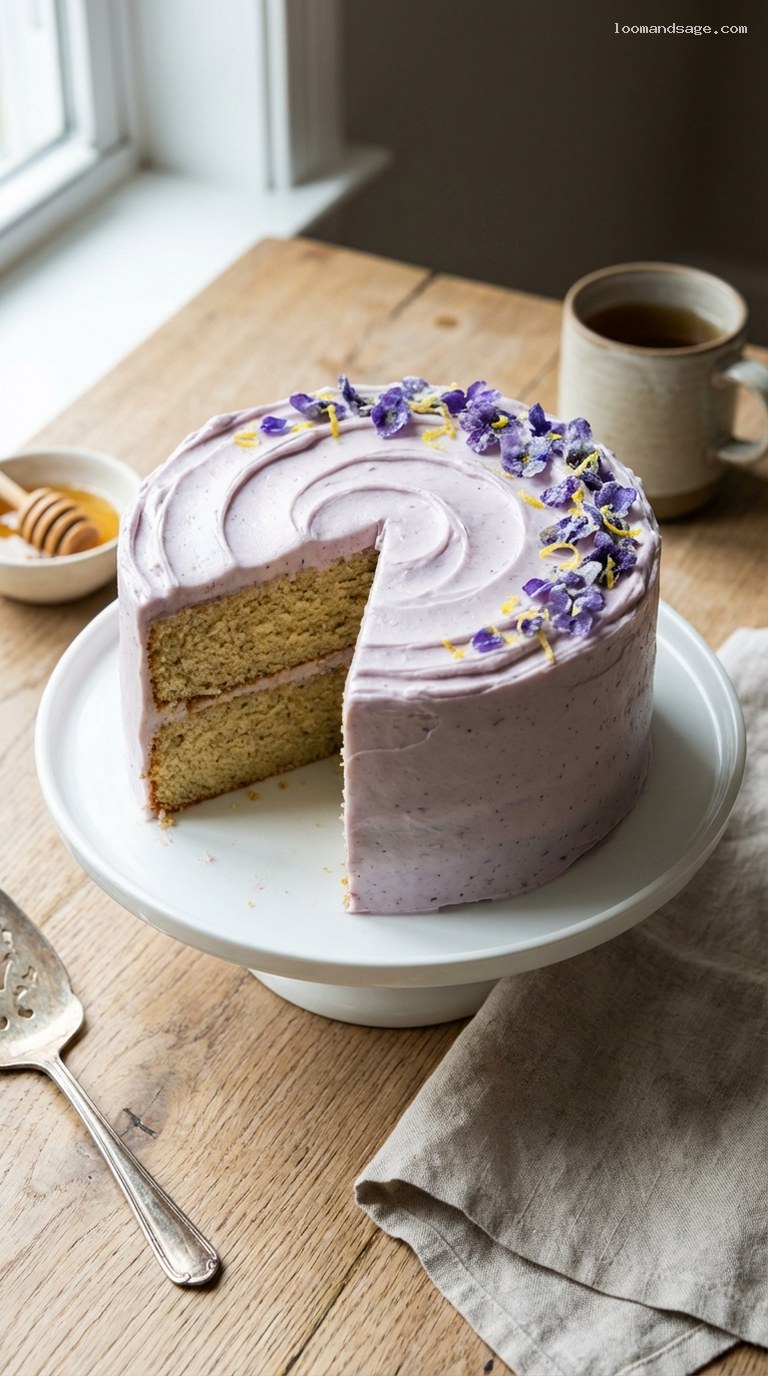
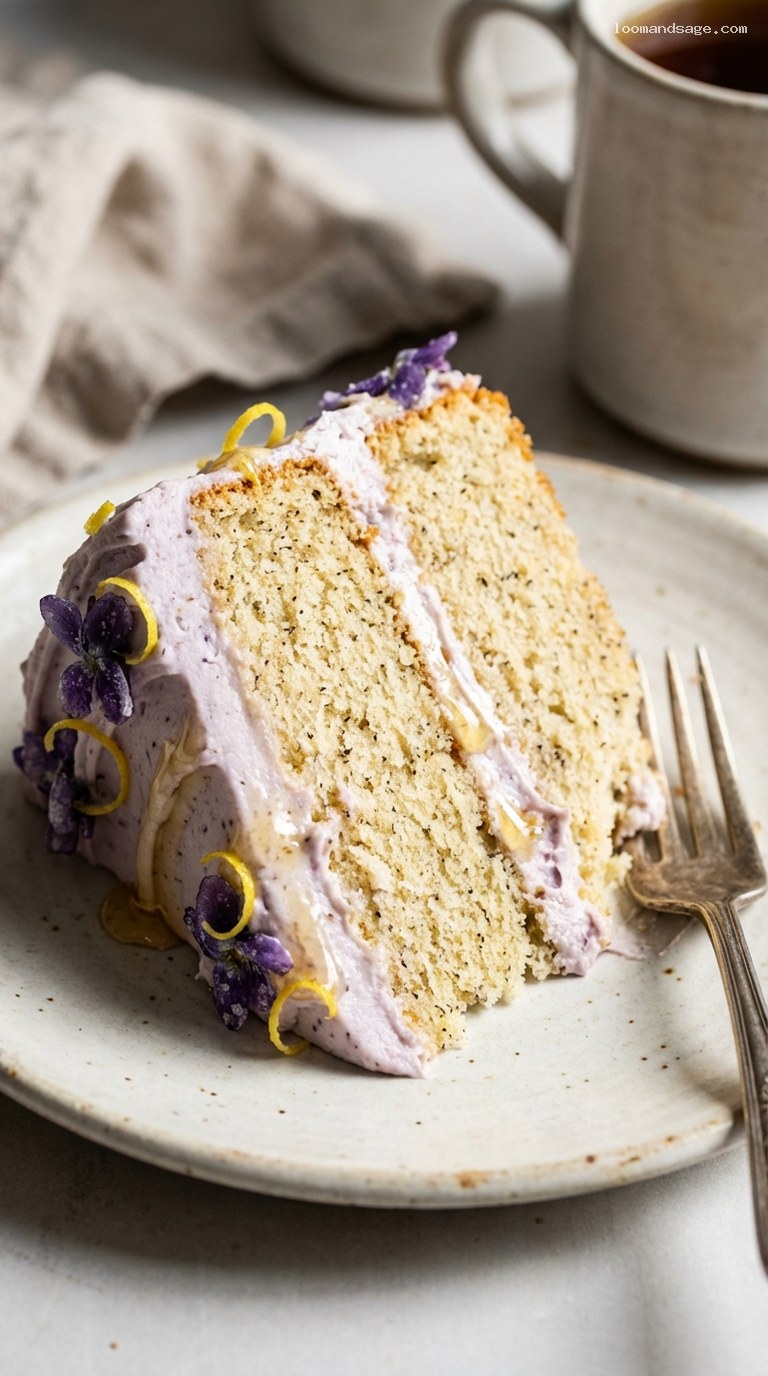
Once the final coat of frosting is on and still slightly soft, gently arrange candied violets over the top of the cake. You can create a loose crescent along one side, a wreath around the edges, or scatter them more organically. Sprinkle the finely grated lemon zest over the top, focusing on the areas between or around the flowers so the colors really pop.
If you are making your own candied violets, lightly brush each flower with a thin coating of beaten pasteurized egg white, then sprinkle generously with superfine sugar on all sides. Lay them on a parchment-lined tray and let them dry at room temperature for several hours (or overnight) until crisp before using. Once decorated, refrigerate the cake for 20–30 minutes to help the buttercream firm up, then slice with a sharp, warm knife for the cleanest layers. Serve at cool room temperature to best appreciate the Earl Grey and honey flavors.
Pro Tips
- Use room-temperature ingredients for the batter (butter, eggs, and tea-infused milk) so everything blends smoothly and the cake rises evenly.
- Steep the Earl Grey and lavender fully, but do not boil them; gentle heat preserves their delicate floral notes without turning bitter.
- Choose a light, mild honey rather than a very dark or strongly flavored one, so it enhances rather than overwhelms the Earl Grey.
- For super flat layers, chill the cakes briefly after cooling, then trim with a serrated knife; chilled cake is easier to cut cleanly.
- If your buttercream feels too soft to hold pretty swirls, refrigerate it for 10–15 minutes, then beat briefly to restore a fluffy texture.
Variations
- Earl Grey Vanilla Bean Version: Skip the lavender and honey in the frosting and use the vanilla bean buttercream option for a more classic, crowd-pleasing flavor that still lets the tea and honey in the cake shine.
- Lemon Earl Grey Drizzle: Whisk 1/4 cup (60 ml) honey with 1–2 tbsp freshly squeezed lemon juice and a pinch of salt. Drizzle lightly over the frosted cake just before serving for extra tang and shine.
- Loaf or Tea Cakes: Bake the batter in two 9×5-inch loaf pans (adjust baking time to 35–40 minutes) or in lined cupcake tins (18–20 minutes). Frost with swirls of buttercream and top each with a single candied violet.
Storage & Make-Ahead
The fully frosted cake keeps well, covered, in the refrigerator for up to 3 days. For the best texture and flavor, let slices sit at room temperature for 20–30 minutes before serving so the buttercream softens and the Earl Grey and honey aromas are more pronounced. Unfrosted cake layers can be baked, cooled completely, wrapped tightly in plastic wrap, and refrigerated for up to 2 days or frozen for up to 2 months. Thaw frozen layers in the fridge overnight, then bring to cool room temperature before frosting. Buttercream can be made up to 3 days in advance and stored in an airtight container in the refrigerator; bring it to room temperature and re-whip briefly to restore its lightness before using. Candied violets should be kept in an airtight container in a cool, dry place and used within 1–2 weeks.
Nutrition (per serving)
Approximate values for 1 of 12 slices made with honey lavender buttercream: 520–560 calories; 30–34 g fat; 19–23 g saturated fat; 63–68 g carbohydrates; 47–52 g sugar; 4–6 g protein; 1–2 g fiber; 260–320 mg sodium. These numbers are estimates and will vary based on the specific ingredients and brands you use and how thickly you frost the cake.