Quick Recipe Version (TL;DR)
Quick Ingredients
- Injera: teff flour 2 cups (260 g), all-purpose flour 1 cup (120 g), active dry yeast 1 tsp, fine salt 1 tsp, lukewarm water (90–95°F / 32–35°C) 3 1/2 cups (830 ml), plus boiling water 1/2 cup (120 ml)
- Misir Wot (red lentils): red lentils 1 1/2 cups (300 g), yellow onion 1 large, garlic 4 cloves, ginger 1 tbsp, tomato paste 2 tbsp, berbere spice 2 tbsp, smoked paprika 1 tsp, butter or niter kibbeh 3 tbsp (or olive oil), vegetable broth/water 4 cups (960 ml), fine salt 1 1/4 tsp
- Atkilt Wot (cabbage, carrots, potatoes): green cabbage 1/2 small head (about 1 lb / 450 g), carrots 3 medium, Yukon Gold potatoes 2 medium, yellow onion 1 small, garlic 3 cloves, ginger 1 tsp, turmeric 1 tsp, black pepper 1/2 tsp, olive oil 3 tbsp, water 1/2 cup (120 ml), fine salt 1 tsp
- Gomen (sautéed collards): collard greens 1 bunch (12 oz / 340 g), yellow onion 1 small, garlic 3 cloves, olive oil or butter 2 tbsp, lemon juice 1 tbsp, fine salt 3/4 tsp
- To serve: extra berbere (optional), lemon wedges (optional)
Do This
- 1. Mix injera batter (teff + flour + yeast + water + salt). Cover and ferment 12 hours at room temperature (72–78°F / 22–26°C).
- 2. Make absit: stir 1 cup fermented batter with 1/2 cup boiling water; whisk back into the bowl. Rest 30 minutes.
- 3. Cook misir wot: sauté onion, then add butter/oil, garlic, ginger, tomato paste, berbere; simmer lentils in broth 25–30 minutes.
- 4. Cook atkilt wot: sauté onion with turmeric, add cabbage/carrots/potatoes and 1/2 cup water; cover-simmer 18–22 minutes.
- 5. Cook gomen: sauté onion + garlic; add collards and cook 8–10 minutes; finish with lemon.
- 6. Cook injera: pour 1/2 cup batter into a 12-inch nonstick skillet at medium-low; cover and steam-cook 2–3 minutes (no flipping).
- 7. Assemble platter: lay injera as the base, pile stews/veg on top, and serve with extra injera for scooping.
Why You’ll Love This Recipe
- True hands-on, communal eating: injera doubles as plate and utensil, perfect for sharing.
- Big flavor, approachable method: a yeast-assisted fermentation gives tang without days of waiting.
- A complete meal on one platter: lentil stew + two vegetables cover protein, fiber, and color.
- Meal-prep friendly: the stews reheat beautifully, and injera can be made ahead and warmed.
Grocery List
- Produce: yellow onions (3), garlic (10 cloves), fresh ginger, green cabbage (1/2 small head), carrots (3), Yukon Gold potatoes (2), collard greens (1 bunch), lemon (1)
- Dairy: butter (or niter kibbeh/spiced clarified butter, optional)
- Pantry: teff flour, all-purpose flour, active dry yeast, red lentils, tomato paste, berbere spice blend, smoked paprika, ground turmeric, olive oil, vegetable broth (or water), fine salt, black pepper
Full Ingredients
Injera (yeast-assisted, home-cook friendly)
- Teff flour: 2 cups (260 g)
- All-purpose flour: 1 cup (120 g)
- Active dry yeast: 1 teaspoon
- Fine salt: 1 teaspoon
- Lukewarm water (90–95°F / 32–35°C): 3 1/2 cups (830 ml)
- Boiling water (for absit): 1/2 cup (120 ml)
- Neutral oil (for pan, optional if truly nonstick): 1/2 teaspoon
Misir Wot (Ethiopian-style red lentil stew)
- Red lentils, rinsed: 1 1/2 cups (300 g)
- Yellow onion, finely diced: 1 large (about 2 cups / 300 g)
- Garlic, minced: 4 cloves
- Fresh ginger, grated: 1 tablespoon
- Tomato paste: 2 tablespoons
- Berbere spice blend: 2 tablespoons (use 1 tablespoon for mild)
- Smoked paprika: 1 teaspoon
- Butter or niter kibbeh: 3 tablespoons (or olive oil for vegan)
- Vegetable broth or water: 4 cups (960 ml)
- Fine salt: 1 1/4 teaspoons
- Water (to adjust consistency, if needed): 1/2 cup (120 ml)
Atkilt Wot (cabbage, carrots, and potatoes)
- Yellow onion, thinly sliced: 1 small (about 1 cup / 150 g)
- Garlic, minced: 3 cloves
- Fresh ginger, grated: 1 teaspoon
- Olive oil: 3 tablespoons
- Ground turmeric: 1 teaspoon
- Black pepper: 1/2 teaspoon
- Green cabbage, cut into 1-inch pieces: 1/2 small head (about 1 lb / 450 g)
- Carrots, sliced into 1/4-inch coins: 3 medium (about 10 oz / 280 g)
- Yukon Gold potatoes, cut into 3/4-inch cubes: 2 medium (about 1 lb / 450 g)
- Water: 1/2 cup (120 ml)
- Fine salt: 1 teaspoon
Gomen (sautéed collard greens)
- Collard greens, stems removed, thinly sliced: 12 oz (340 g)
- Yellow onion, thinly sliced: 1 small (about 1 cup / 150 g)
- Garlic, minced: 3 cloves
- Olive oil or butter: 2 tablespoons
- Fine salt: 3/4 teaspoon
- Water (as needed to prevent sticking): 2 tablespoons
- Lemon juice: 1 tablespoon
For the platter
- Extra injera (from this batch), kept warm and covered
- Berbere, for sprinkling: 1/2 teaspoon (optional)
- Lemon wedges (optional)
Step-by-Step Instructions
Step 1: Mix the injera batter
In a large bowl, whisk together 2 cups (260 g) teff flour, 1 cup (120 g) all-purpose flour, and 1 teaspoon active dry yeast. Add 3 1/2 cups (830 ml) lukewarm water (90–95°F / 32–35°C) and whisk until smooth and pourable (similar to crêpe batter). Whisk in 1 teaspoon fine salt.
Cover the bowl with a lid or plate (not airtight) and let it ferment at 72–78°F (22–26°C) for 12 hours. The batter should smell pleasantly tangy and show bubbles on the surface.
Step 2: Make the absit and rest the batter (key for spongy texture)
After fermentation, stir the batter. Measure out 1 cup of the fermented batter into a small saucepan. Set the remaining batter aside.
Bring 1/2 cup (120 ml) water to a boil. With the saucepan on medium heat, whisk the boiling water into the 1 cup batter. Cook, whisking constantly, for 1–2 minutes, until it thickens to a glossy paste (like loose mashed potatoes). This is the absit and helps create the classic “eyes” (holes).
Scrape the warm paste back into the main bowl and whisk well until the batter is smooth again. Let the batter rest, uncovered, for 30 minutes at room temperature. If the batter has thickened too much, whisk in additional water 1 tablespoon at a time until it flows easily off a ladle.
Step 3: Start the misir wot (build deep flavor)
While the batter rests, make the stew. In a medium pot, heat 3 tablespoons butter (or oil) over medium heat. Add 1 large finely diced onion and cook for 8–10 minutes, stirring often, until soft and lightly golden. If the onions start to stick, add 1–2 tablespoons water and keep going.
Add 4 minced garlic cloves and 1 tablespoon grated ginger; cook 30 seconds until fragrant. Stir in 2 tablespoons tomato paste, 2 tablespoons berbere, and 1 teaspoon smoked paprika. Cook 1 minute, stirring, to toast the spices.
Step 4: Simmer the lentils until creamy
Add the rinsed 1 1/2 cups (300 g) red lentils and 4 cups (960 ml) vegetable broth or water. Bring to a boil over high heat, then reduce to a gentle simmer over low heat.
Simmer, partially covered, for 25–30 minutes, stirring every 5 minutes, until the lentils are soft and the stew is thick and spoonable. Stir in 1 1/4 teaspoons fine salt. If it becomes too thick, add up to 1/2 cup (120 ml) water, a little at a time, until it’s creamy.
Step 5: Cook the atkilt wot (tender vegetables, not mushy)
In a wide pot or deep skillet, heat 3 tablespoons olive oil over medium heat. Add 1 small sliced onion and cook 4 minutes until softened. Add 3 minced garlic cloves and 1 teaspoon grated ginger; cook 30 seconds.
Stir in 1 teaspoon turmeric, 1/2 teaspoon black pepper, and 1 teaspoon fine salt. Add the cabbage, carrots, and potatoes, tossing to coat in the spices and oil. Pour in 1/2 cup (120 ml) water, cover, and simmer on medium-low for 18–22 minutes, stirring twice, until potatoes are fork-tender and cabbage is silky but still has some shape.
Step 6: Sauté the gomen (collards) and finish with lemon
In a large skillet, heat 2 tablespoons olive oil (or butter) over medium heat. Add 1 small sliced onion and cook for 4–5 minutes until soft. Add 3 minced garlic cloves and cook 30 seconds.
Add the sliced collard greens and 3/4 teaspoon salt. Cook for 8–10 minutes, tossing often, until tender and glossy. If the pan seems dry, add 2 tablespoons water to help steam the greens. Turn off the heat and stir in 1 tablespoon lemon juice.
Step 7: Cook the injera (steam-cook, no flipping)
Heat a 12-inch nonstick skillet over medium-low heat for 3 minutes. If your pan isn’t very nonstick, wipe it with a paper towel dipped in 1/2 teaspoon neutral oil (a very thin film).
Stir the batter gently. Pour in 1/2 cup batter, immediately swirling the pan to spread it into a thin, even round. Cover with a tight-fitting lid and cook for 2–3 minutes, until the surface is covered in “eyes” (tiny holes) and the top looks dry. The edges should lift slightly. Do not flip.
Slide the injera onto a clean towel or plate. Cover with another towel to keep warm. Repeat with the remaining batter (you should get about 8 injera).
Step 8: Assemble the Ethiopian injera platter and serve
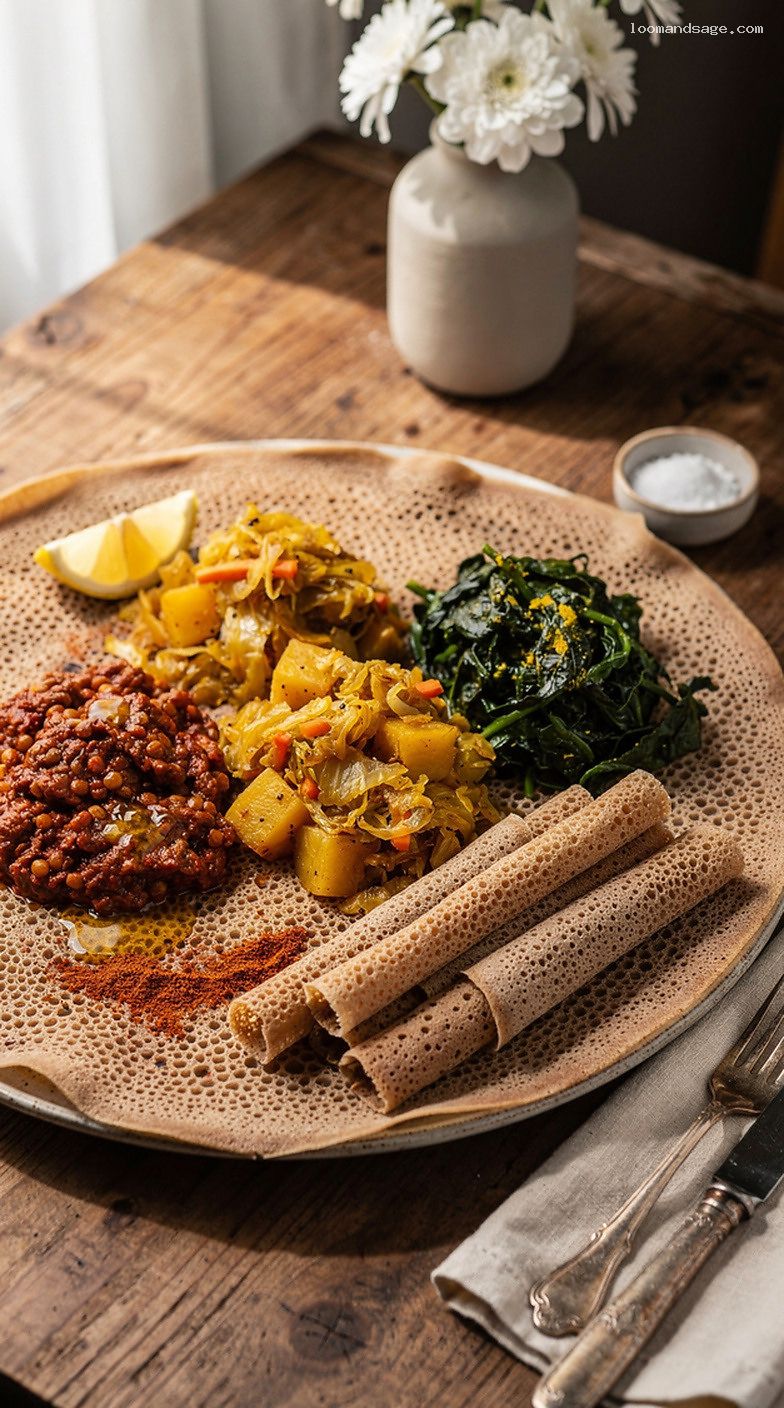
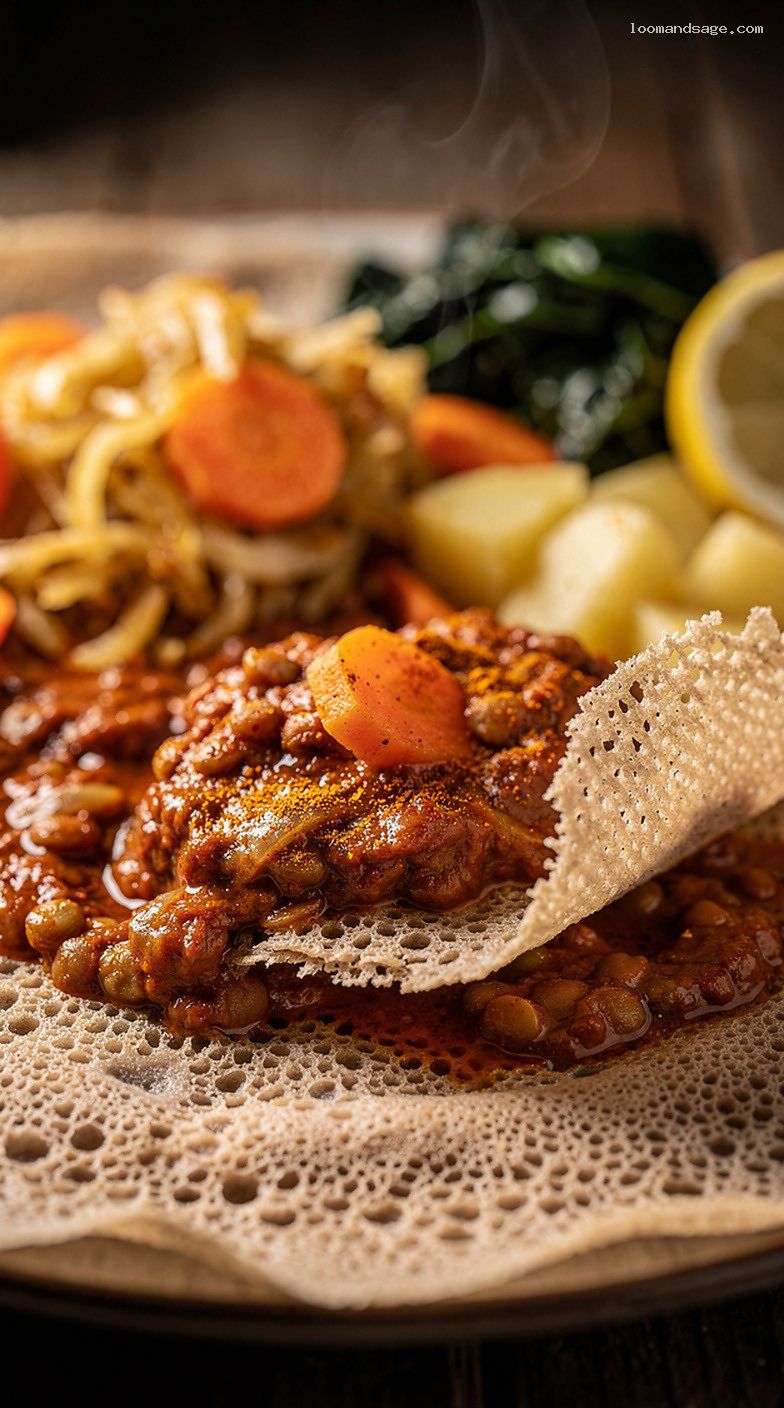
Place 1–2 injera on a large platter as the base (overlapping is fine). Spoon the misir wot into one mound, the atkilt wot into another, and the gomen into a third, keeping them separate like a colorful trio.
Lay a few folded strips of injera around the edges for scooping. If you like, sprinkle the lentils with 1/2 teaspoon berbere for a deeper red color and a little extra heat. Serve immediately while everything is warm, and eat by tearing off pieces of injera and scooping up the stews and vegetables.
Pro Tips
- Keep the batter pourable: injera batter should flow easily. After resting, adjust with water 1 tablespoon at a time until it pours like crêpe batter.
- Control heat for “eyes”: too hot and the bottom scorches before holes form; too low and it dries out slowly. Aim for medium-low and adjust as needed.
- Cover tightly: the lid traps steam, which sets the top. A clear glass lid helps you monitor without lifting.
- Berbere varies a lot: if yours is extra spicy or salty, start with 1 tablespoon and add more at the end.
- Make it a true platter: use a large, flat serving tray and keep components in separate piles so everyone can build their perfect bite.
Variations
- Gluten-free injera: replace the all-purpose flour with 1 cup (120 g) certified gluten-free oat flour or additional teff flour. Note: 100% teff is more fragile; keep the injera slightly thicker and handle gently.
- Extra-protein platter: add hard-boiled eggs to the misir wot (halve 6 eggs and warm them in the stew for 3 minutes).
- More heat and aroma: finish misir wot with 1 tablespoon additional niter kibbeh (or butter) melted on top right before serving.
Storage & Make-Ahead
Injera: Cool completely, then stack with parchment or plastic wrap between pieces. Store airtight in the refrigerator for 3 days. Reheat by steaming: place injera on a plate, cover with a slightly damp towel, and microwave on 50% power for 45–60 seconds, or warm in a covered skillet over low heat for 1–2 minutes.
Misir wot, atkilt wot, and gomen: Refrigerate in airtight containers for 4 days. Reheat gently on the stovetop over medium-low heat until hot, adding 1–3 tablespoons water if needed. Misir wot thickens as it sits and often tastes even better the next day.
Make-ahead plan: Ferment the injera batter overnight. The next day, cook the stews while the batter rests, then cook injera last so it’s warm and pliable for serving.
Nutrition (per serving)
Approximate, per 1/6 of platter (includes injera, misir wot, atkilt wot, and gomen): 670 calories, 18 g protein, 108 g carbohydrates, 18 g fat, 22 g fiber, 1,150 mg sodium. Values vary by brand of berbere, broth, and exact injera yield.