
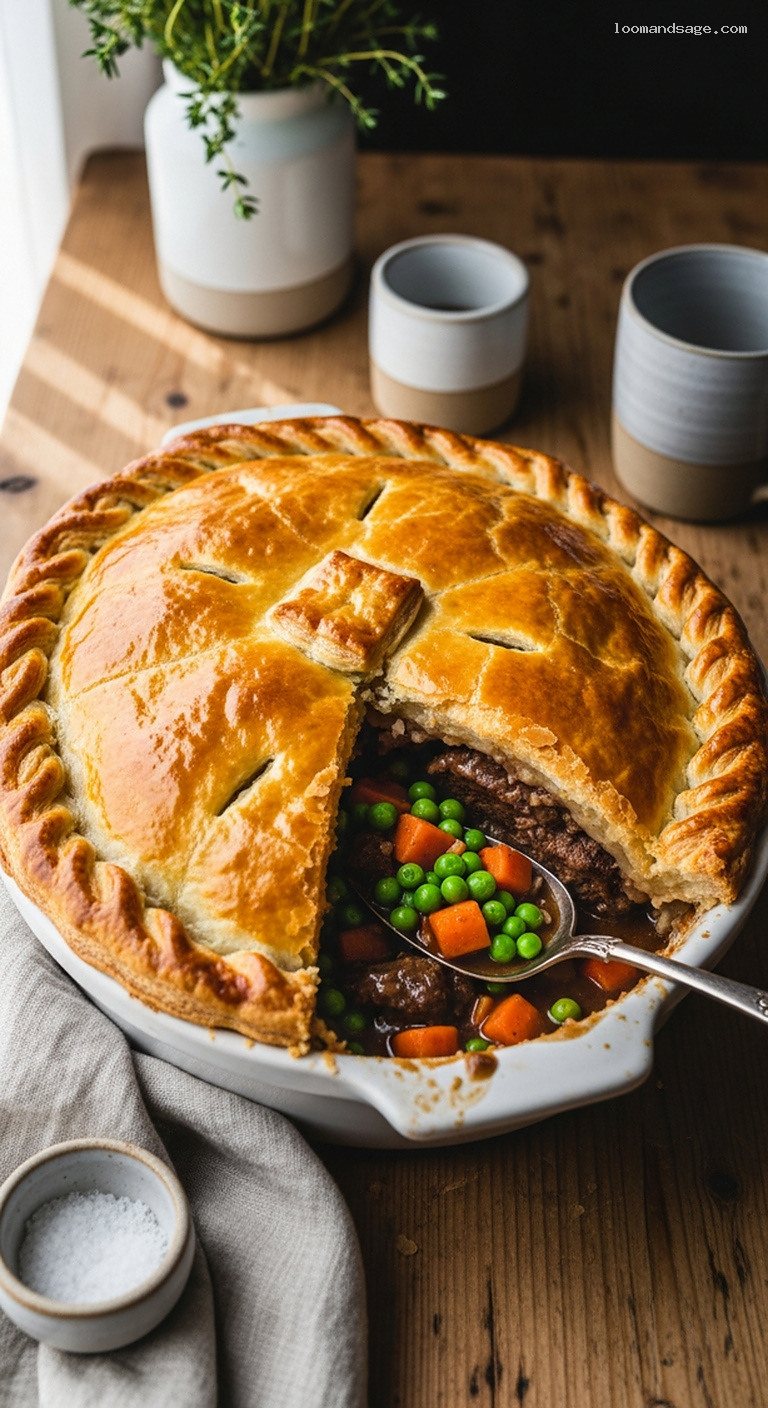
Quick Recipe Version (TL;DR)
Quick Ingredients
- 2 1/2 lb (1.1 kg) boneless lamb shoulder, 1-inch cubes
- Salt, black pepper, 1/4 cup all-purpose flour (for dredging)
- 2 tbsp olive oil, 3 tbsp butter
- 1 large onion, 2 medium carrots, 2 celery stalks, 3 garlic cloves (all chopped)
- 1 cup dry red wine (or extra stock), 3 cups beef or lamb stock
- 2 tbsp tomato paste, 1 tbsp Worcestershire sauce
- 2 tsp fresh thyme leaves, 1 tsp chopped fresh rosemary, 1 bay leaf
- 1 cup frozen peas
- 2 tbsp all-purpose flour (for thickening)
- 2 sheets puff pastry (about 17 oz / 500 g total), thawed
- 1 egg + 1 tbsp water (egg wash)
Do This
- 1. Season lamb with salt and pepper, toss in 1/4 cup flour. Brown in hot oil, then set aside.
- 2. In same pot, sauté onion, carrot, celery; add garlic, tomato paste, herbs, and bay leaf.
- 3. Deglaze with red wine, add stock and Worcestershire; return lamb, simmer gently 1 1/2–2 hours until very tender.
- 4. Make a butter-flour paste (2 tbsp flour + 3 tbsp butter); whisk into simmering lamb to thicken. Stir in peas. Cool until just warm.
- 5. Heat oven to 400°F (200°C). Spoon filling into a 2-quart baking dish or 6 ramekins. Top with puff pastry, trim, crimp edges, cut steam vents, brush with egg wash.
- 6. Bake 25–30 minutes until pastry is puffed and deep golden. Rest 5–10 minutes before serving.
Why You’ll Love This Recipe
- Slow-cooked lamb becomes incredibly tender and flavorful in a rich, glossy gravy.
- Flaky golden puff pastry on top gives you all the comfort of a classic pot pie with minimal fuss.
- Peas and carrots add sweetness, color, and balance to the savory lamb.
- Great for making ahead: the filling can be cooked a day in advance, then topped with pastry and baked when you are ready.
Grocery List
- Produce: 1 large onion, 2 medium carrots, 2 celery stalks, 3 garlic cloves, fresh thyme, fresh rosemary (or dried), fresh parsley (optional for garnish), 1 bay leaf, fresh thyme sprigs for garnish (optional)
- Dairy: Unsalted butter, 1 large egg
- Pantry: Boneless lamb shoulder, olive oil, all-purpose flour, beef or lamb stock, dry red wine (or extra stock), tomato paste, Worcestershire sauce, frozen peas, puff pastry sheets (frozen), salt, black pepper
Full Ingredients
Lamb Filling
- 2 1/2 lb (1.1 kg) boneless lamb shoulder, trimmed and cut into 1-inch cubes
- 1 1/2 tsp fine sea salt (plus more to taste)
- 1 tsp freshly ground black pepper (plus more to taste)
- 1/4 cup (30 g) all-purpose flour, for dredging the lamb
- 2 tbsp olive oil
- 1 large onion, finely chopped
- 2 medium carrots, peeled and diced (about 1/4–1/2 inch pieces)
- 2 celery stalks, diced
- 3 garlic cloves, minced
- 2 tbsp tomato paste
- 2 tsp fresh thyme leaves (or 1 tsp dried thyme)
- 1 tsp finely chopped fresh rosemary (or 1/2 tsp dried rosemary, crushed)
- 1 bay leaf
- 1 cup (240 ml) dry red wine (or substitute with 1 cup extra stock)
- 3 cups (720 ml) beef or lamb stock, preferably low-sodium
- 1 tbsp Worcestershire sauce
- 1 cup (140 g) frozen peas (no need to thaw)
Gravy Thickener
- 3 tbsp unsalted butter, softened
- 2 tbsp (15 g) all-purpose flour
Pastry Topping
- 2 sheets puff pastry (about 17 oz / 500 g total), thawed but still cold
- 1 large egg
- 1 tbsp water
- Flaky sea salt, for sprinkling (optional)
- Fresh thyme leaves or chopped parsley, for garnish (optional)
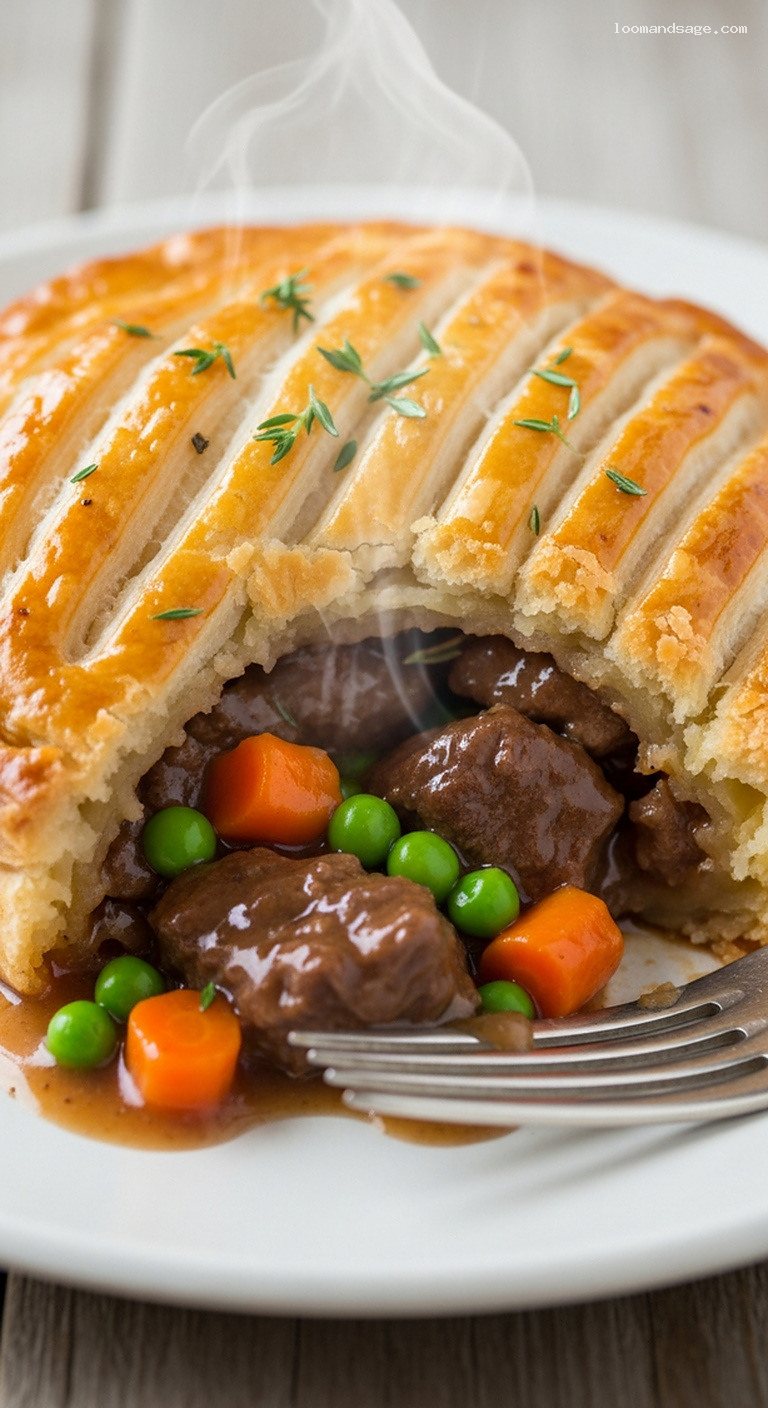
Step-by-Step Instructions
Step 1: Prep the lamb and vegetables
Pat the lamb pieces dry with paper towels. This helps them brown properly. Sprinkle the lamb evenly with 1 1/2 teaspoons salt and 1 teaspoon black pepper. Toss to coat.
Place 1/4 cup flour in a large bowl. Add the seasoned lamb and toss until the pieces are lightly and evenly dusted, shaking off any excess flour. Set aside while you prepare the vegetables.
Finely chop the onion. Dice the carrots and celery into small, even pieces so they cook at the same rate. Mince the garlic. Have the tomato paste, herbs, wine, stock, and Worcestershire sauce measured and ready to go.
Step 2: Brown the lamb
Heat a large, heavy-bottomed pot or Dutch oven over medium-high heat. Add the olive oil and let it heat until shimmering but not smoking.
Add about half of the lamb in a single layer (do not crowd the pot) and brown it on all sides, about 6–8 minutes total. Turn the pieces occasionally to get deep, brown color. Transfer the browned lamb to a plate. Repeat with the remaining lamb, adding a drizzle more oil if needed.
Do not rush this step: good browning builds deep flavor in the final gravy.
Step 3: Build the flavor base
Turn the heat down to medium. In the same pot (do not clean it), add the chopped onion, carrot, and celery. If the pot looks dry, add 1–2 teaspoons more oil. Cook, stirring often, until the vegetables soften and start to take on a little color, about 6–8 minutes.
Add the minced garlic and cook for 30 seconds until fragrant. Stir in the tomato paste and cook for 1–2 minutes, stirring constantly, until it darkens slightly in color. This helps remove its raw flavor.
Stir in the thyme, rosemary, and bay leaf. Pour in the red wine, scraping up any browned bits from the bottom of the pot with a wooden spoon. Let the wine bubble for 2–3 minutes to reduce slightly.
Step 4: Simmer the lamb until tender
Pour in the stock and Worcestershire sauce and stir to combine. Return the browned lamb and any juices on the plate to the pot. Bring the mixture just up to a gentle boil, then immediately reduce the heat to low to maintain a very gentle simmer.
Cover partially with a lid (slightly ajar) and simmer for 1 1/2 to 2 hours, stirring occasionally, until the lamb is very tender and easily pulls apart with a fork. Adjust the heat as needed to keep it at a low, lazy bubble rather than a vigorous boil.
When the lamb is tender, taste the broth and adjust seasoning with a little more salt and pepper if needed.
Step 5: Thicken the gravy and add peas
In a small bowl, mash together the softened butter and 2 tablespoons flour with a fork to form a smooth paste (this is called a beurre manié). This will thicken the gravy without lumps.
Bring the lamb mixture back to a gentle simmer. Whisk in the butter-flour paste a spoonful at a time, stirring well after each addition. Simmer for 5–10 minutes, stirring often, until the gravy is thick enough to coat the back of a spoon. If it becomes too thick, add a splash more stock or water to loosen it.
Stir in the frozen peas. Simmer for 2–3 minutes more. Remove and discard the bay leaf. Turn off the heat.
Let the filling cool until it is warm rather than piping hot, about 20–30 minutes. Hot filling can melt the pastry fat and make the crust greasy or soggy, so this cooling step is important.
Step 6: Prepare the pastry and assemble the pie
While the filling is cooling, heat your oven to 400°F (200°C) with a rack in the center. If using a single large dish, lightly butter a 2-quart (about 2-liter) baking dish. For individual pies, grease six 10–12 oz (300–350 ml) ramekins.
On a lightly floured surface, gently unfold the thawed puff pastry sheets. Roll them out slightly to smooth the seams and make them large enough to cover your baking dish or ramekins with a small overhang. For ramekins, cut circles about 1/2 inch (1 cm) wider than the tops.
Spoon the warm lamb filling into your dish or ramekins, leaving about 1/2 inch (1 cm) at the top to prevent overflow while baking.
Place the pastry over the top, letting it drape over the edges. Press or crimp the edges to seal. Use a sharp knife to cut 3–4 small slits in the center of each pie to allow steam to escape.
In a small bowl, beat the egg with 1 tablespoon water. Brush the pastry lightly and evenly with the egg wash. Sprinkle with a pinch of flaky sea salt if you like.
Step 7: Bake until golden and serve
Place the pie (or pies) on a rimmed baking sheet to catch any drips. Bake at 400°F (200°C) for 25–30 minutes, or until the pastry is deeply golden, puffed, and crisp.
Remove from the oven and let rest for 5–10 minutes. This allows the gravy to settle slightly so it is not too runny when you serve.
Sprinkle with fresh thyme leaves or chopped parsley just before serving for a fresh, colorful finish. Serve hot, making sure everyone gets plenty of tender lamb, vegetables, and flaky crust in each portion.
Pro Tips
- Use the right cut of lamb: Lamb shoulder is ideal because it has enough fat and connective tissue to become meltingly tender after a long, gentle simmer.
- Do not skip browning: Properly browning the lamb and lightly caramelizing the vegetables builds deep, savory flavor that makes the gravy rich and complex.
- Cool the filling slightly: Letting the lamb mixture cool to warm before adding pastry prevents the butter in the dough from melting too early, which is key for a flaky crust.
- Vent the crust: Cutting small slits in the pastry allows steam to escape so the crust stays crisp instead of soggy.
- Protect the edges if needed: If your pastry edges brown too quickly, loosely cover them with foil during the last 5–10 minutes of baking.
Variations
- Root vegetable boost: Swap half of the carrots with diced parsnips or turnips for an earthier, more rustic filling.
- Herb and garlic twist: Add a teaspoon of Dijon mustard and a handful of chopped fresh parsley to the filling at the end of cooking for a brighter, more herbal flavor.
- Cottage pie style (no pastry): Skip the puff pastry and top the cooled lamb filling with creamy mashed potatoes. Bake at 400°F (200°C) until the top is golden and crisp.
Storage & Make-Ahead
The lamb filling is perfect for making ahead. Cook it completely, cool to room temperature, then refrigerate in an airtight container for up to 3 days or freeze for up to 2 months. When ready to bake, rewarm the filling gently until just warm (not hot), transfer to your baking dish, top with pastry, and bake as directed, adding 5–10 minutes to the baking time if the filling is very cold.
Leftover baked pot pie can be cooled completely, covered, and refrigerated for up to 3 days. Reheat in a 350°F (175°C) oven for 20–25 minutes, until the filling is hot and the pastry is crisp again. If reheating from frozen, thaw overnight in the refrigerator first for best results.
Nutrition (per serving)
Approximate values per serving (1/6 of recipe, using puff pastry and including gravy): about 650 calories, 38 g protein, 42 g fat, 27 g carbohydrates, 3 g fiber, and 1,250 mg sodium (will vary based on exact ingredients and stock used). Use low-sodium stock and reduce added salt if you need to limit sodium.