Quick Recipe Version (TL;DR)
Quick Ingredients
- 2 1/2 cups (300 g) cake flour
- 2 1/2 tsp baking powder, 1/2 tsp fine salt
- 3/4 cup (170 g) unsalted butter, softened + 1/4 cup (60 ml) neutral oil
- 1 2/3 cups (330 g) granulated sugar
- 3 large eggs + 2 large egg whites, room temperature
- 1 1/2 tsp vanilla extract + 2–3 tsp vanilla bean paste or seeds from 2 vanilla beans (divided between cake and frosting)
- 1 cup (240 ml) whole milk + 1/2 cup (120 g) sour cream, room temperature
- Buttercream option: 1 1/2 cups (340 g) unsalted butter, 4 1/2 cups (540 g) powdered sugar, 3–5 tbsp heavy cream
- Mascarpone option: 8 oz (225 g) mascarpone, 1 3/4 cups (420 ml) heavy cream, 1/2 cup (60 g) powdered sugar
- Fresh berries and/or edible flowers for decorating
Do This
- 1. Preheat oven to 350°F (177°C). Grease and line two 8-inch round cake pans with parchment. Whisk flour, baking powder, and salt.
- 2. Cream butter, oil, and sugar until very fluffy. Beat in eggs and egg whites one at a time, then vanilla extract and vanilla bean paste/seeds.
- 3. Mix in dry ingredients alternately with milk and sour cream, beginning and ending with dry. Divide batter between pans and bake 25–30 minutes.
- 4. Cool cakes in pans 10–15 minutes, then turn out onto racks to cool completely.
- 5. Make either vanilla bean buttercream or whipped vanilla mascarpone frosting. Beat until smooth and spreadable.
- 6. Level cakes if needed. Fill and stack with frosting, then crumb-coat, chill briefly, and finish frosting. Decorate simply with fresh berries and/or edible flowers.
Why You’ll Love This Recipe
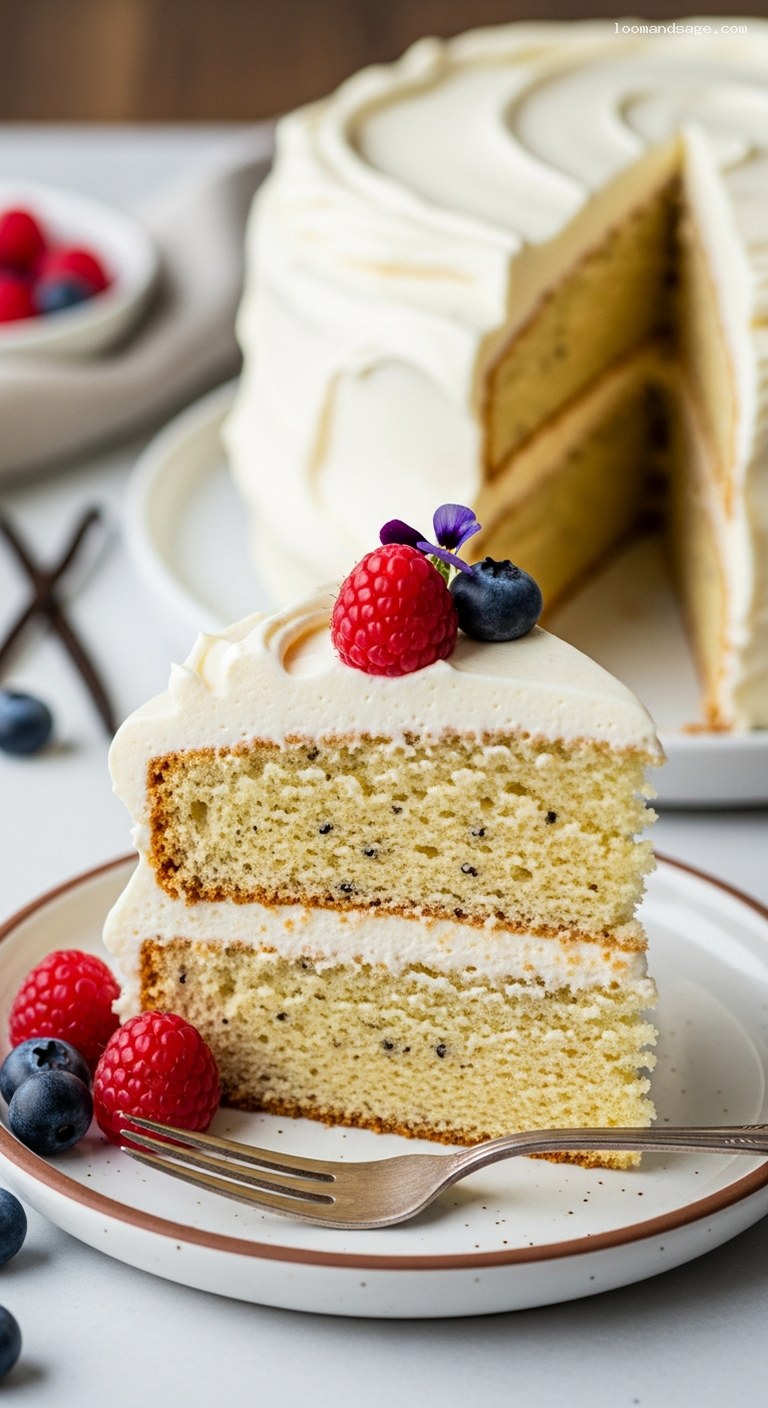
- Intense, pure vanilla flavor from real vanilla bean paste or scraped vanilla beans, with beautiful specks in every bite.
- Soft, tender cake layers that stay moist thanks to a blend of butter, oil, milk, and sour cream.
- Two frosting options: a classic vanilla bean buttercream or a light, cloud-like whipped mascarpone frosting.
- Elegant, minimal decoration with fresh flowers or berries that makes the cake look bakery-worthy with very little effort.
Grocery List
- Produce: Fresh berries (raspberries, strawberries, blueberries, or blackberries), edible flowers (unsprayed roses, pansies, violas, chamomile, or other food-safe blooms).
- Dairy: Unsalted butter, whole milk, sour cream, heavy cream, mascarpone cheese (for mascarpone frosting option).
- Pantry: Cake flour, granulated sugar, powdered (confectioners’) sugar, baking powder, fine sea salt, neutral oil (canola or vegetable), pure vanilla extract, vanilla bean paste and/or whole vanilla beans, parchment paper.
Full Ingredients
Vanilla Bean Cake Layers
- 2 1/2 cups (300 g) cake flour, spooned and leveled
- 2 1/2 tsp baking powder
- 1/2 tsp fine sea salt
- 3/4 cup (170 g) unsalted butter, softened to room temperature
- 1/4 cup (60 ml) neutral oil (canola or vegetable)
- 1 2/3 cups (330 g) granulated sugar
- 3 large eggs, room temperature
- 2 large egg whites, room temperature
- 1 tsp pure vanilla extract
- 1 1/2 tsp vanilla bean paste or seeds scraped from 1 plump vanilla bean
- 1 cup (240 ml) whole milk, room temperature
- 1/2 cup (120 g) full-fat sour cream, room temperature
Frosting Options (Choose One)
Option 1: Vanilla Bean Buttercream
- 1 1/2 cups (340 g) unsalted butter, very soft but not melted
- 4 1/2 cups (540 g) powdered (confectioners’) sugar, sifted
- 2 tsp vanilla bean paste or seeds from 1 plump vanilla bean
- 1/2–1 tsp pure vanilla extract (to taste)
- 3–5 tbsp heavy cream, room temperature, as needed for consistency
- 1/4 tsp fine sea salt (or to taste)
Option 2: Whipped Vanilla Mascarpone Frosting
- 8 oz (225 g) mascarpone cheese, cold
- 1 3/4 cups (420 ml) heavy cream, very cold
- 1/2 cup (60 g) powdered (confectioners’) sugar, sifted
- 1 1/2 tsp vanilla bean paste or seeds from 1 plump vanilla bean
- 1 tsp pure vanilla extract
- Pinch fine sea salt
For Decorating
- 1–2 cups mixed fresh berries (raspberries, strawberries, blueberries, or blackberries)
- Small handful of fresh edible flowers (optional but beautiful)
Step-by-Step Instructions
Step 1: Prepare the pans and preheat the oven
Preheat your oven to 350°F (177°C). Lightly grease two 8-inch round cake pans with butter or nonstick spray. Line the bottoms with parchment circles, then lightly grease the parchment as well. If you have time, dust the sides with a little cake flour and tap out the excess. This helps the cakes release cleanly and gives you neat layers.
Set a wire cooling rack nearby for later. Having everything ready before you start mixing ensures your batter does not sit too long.
Step 2: Mix the dry ingredients
In a medium bowl, whisk together the cake flour, baking powder, and salt until well combined and lump-free. Set aside. This step evenly distributes the leavening and salt so your cake rises evenly and has consistent flavor.
Step 3: Cream the butter, oil, sugar, and eggs
In a large mixing bowl (or the bowl of a stand mixer fitted with the paddle attachment), add the softened butter, neutral oil, and granulated sugar. Beat on medium-high speed for 3–4 minutes, scraping down the bowl once or twice, until the mixture is very pale and fluffy. This incorporates air and is key to a light, tender crumb.
Add the eggs and egg whites one at a time, beating well after each addition on medium speed. Scrape the bowl as needed. The mixture may look slightly curdled as you add the eggs, but it will smooth out as you continue mixing.
Mix in the vanilla extract and vanilla bean paste or scraped vanilla seeds until evenly distributed. You should see lots of tiny vanilla specks throughout the batter.
Step 4: Add the dry ingredients, milk, and sour cream
In a small bowl or measuring jug, whisk together the milk and sour cream until smooth.
With the mixer on low speed, add about one-third of the dry ingredients to the butter mixture. Mix just until almost combined. Add half of the milk-sour cream mixture and mix gently. Repeat with another third of the dry ingredients, the remaining milk mixture, and finally the last third of the dry ingredients. Mix only until the batter is smooth and no streaks of flour remain.
Avoid overmixing at this point, as that can make the cake tough. Use a spatula to gently fold the batter a few times from the bottom of the bowl to ensure everything is evenly combined.
Step 5: Bake the vanilla bean cake layers
Divide the batter evenly between the two prepared pans (a kitchen scale is helpful for even layers, but you can also eyeball it). Smooth the tops with a spatula.
Bake on the center rack for 25–30 minutes, rotating the pans once halfway through, until the cakes are lightly golden and spring back when gently touched in the center, and a toothpick inserted into the center comes out clean or with a few moist crumbs.
Remove the pans from the oven and set them on a wire rack. Cool in the pans for 10–15 minutes, then run a thin knife around the edges and carefully turn the cakes out onto the rack. Peel off the parchment and let the layers cool completely, top-side up, before frosting. This can take 45–60 minutes; the cakes must be fully cool or the frosting will melt.
Step 6: Make your frosting (choose buttercream or mascarpone)
For Vanilla Bean Buttercream: In a large bowl, beat the softened butter on medium-high speed for 2–3 minutes until very creamy and pale. Add half of the sifted powdered sugar and mix on low until mostly combined (to avoid a sugar cloud), then beat on medium for 1–2 minutes. Add the remaining powdered sugar, vanilla bean paste or seeds, vanilla extract, and salt. Beat on medium-high for 2–3 minutes, adding heavy cream 1 tablespoon at a time until the frosting is smooth, fluffy, and spreadable. Taste and adjust vanilla or salt as desired.
For Whipped Vanilla Mascarpone Frosting: In a large chilled bowl, whisk together the cold mascarpone, powdered sugar, vanilla bean paste or seeds, vanilla extract, and salt on low speed just until smooth and combined (do not overbeat or the mascarpone can become grainy). With the mixer on medium speed, slowly pour in the cold heavy cream. Increase speed to medium-high and whip until the mixture becomes thick, smooth, and holds medium-firm peaks, 1–3 minutes. Watch closely; stopping as soon as you have a billowy, stable frosting.
Step 7: Level, fill, and stack the cake
If your cake layers are domed, use a long serrated knife to carefully slice off the rounded tops, creating flat surfaces. Save the trimmings for snacking or crumbling over ice cream.
Place a small dollop of frosting on your serving plate or cake stand and set the first cake layer, cut-side up, on top. This frosting “glue” keeps the cake from sliding. Spread an even layer of frosting (about 1–1 1/2 cups) over the top, pushing it just to the edges.
Place the second cake layer on top, cut-side down to give you a perfectly flat top. Gently press to level.
Step 8: Crumb-coat, frost, and decorate
Use an offset spatula to spread a thin layer of frosting over the top and sides of the cake, just thick enough to trap any loose crumbs. This is your crumb coat. Chill the cake for 15–20 minutes to set the frosting; this makes the final coat much easier and cleaner.
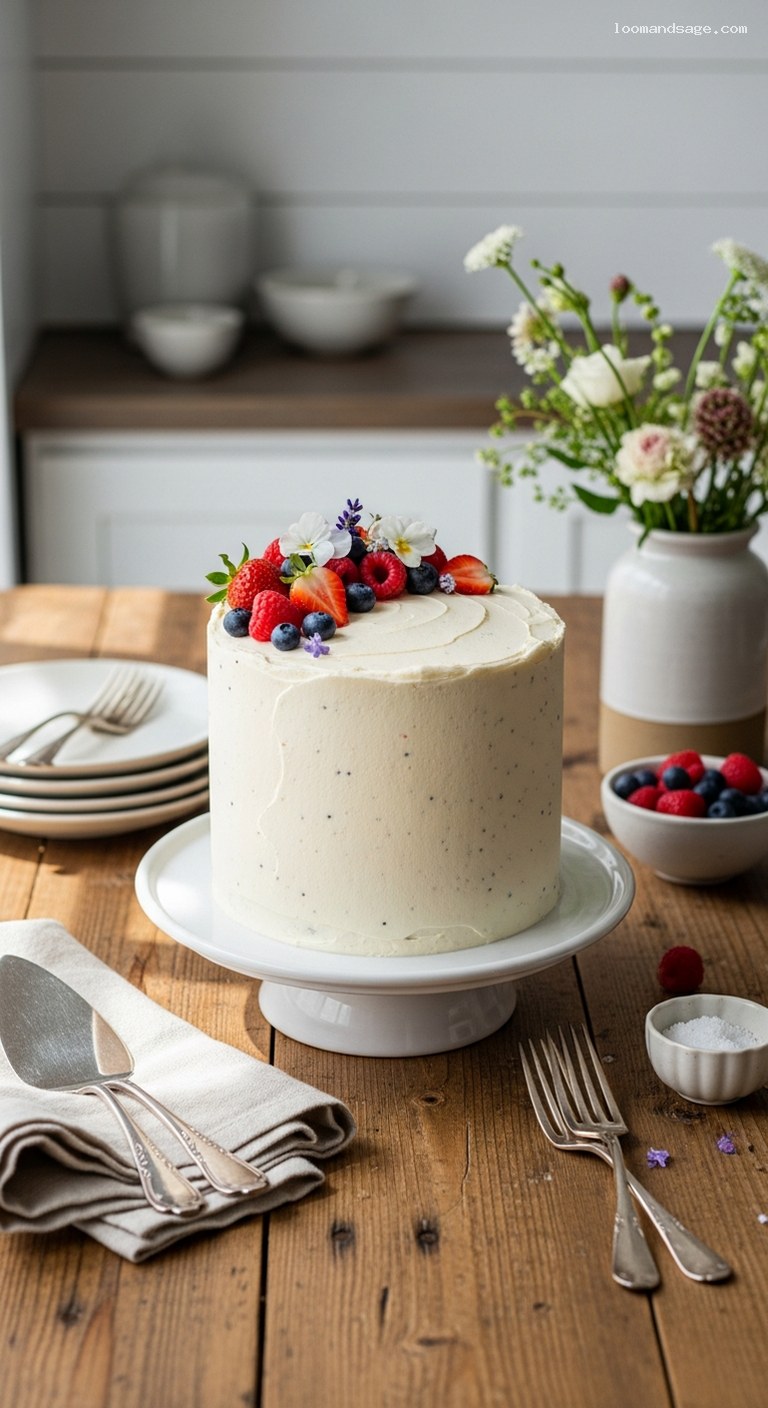
Once chilled, apply a thicker layer of frosting over the top and sides, smoothing it with a spatula or leaving soft, swoopy textures for a rustic look. You should still see tiny vanilla bean specks throughout the frosting.
Decorate simply: arrange fresh berries in a loose cluster on top, and tuck a few edible flowers around them or along one side of the cake. Keep the decoration minimal so the vanilla flavor and speckled frosting remain the star. Refrigerate the cake for at least 20–30 minutes before slicing to help it set for cleaner cuts.
Pro Tips
- Use room-temperature ingredients for the cake. Butter, eggs, milk, and sour cream should all be at room temperature so they emulsify smoothly and create a fine, tender crumb.
- Do not overmix once the flour is added. Mix just until the batter is smooth. Overmixing develops gluten and can make the cake dense or tough.
- Handle mascarpone gently. For the mascarpone frosting, keep the cheese cold and beat only until just smooth; overbeating can cause it to turn grainy or separate.
- Chill between coats of frosting. A quick chill after the crumb coat helps lock in crumbs and makes the final layer of frosting much easier to smooth.
- Use real vanilla bean for special occasions. Vanilla bean paste is wonderful and convenient, but scraped seeds from a fresh bean give the most dramatic specks and a beautifully complex vanilla aroma.
Variations
- Berry-filled vanilla cake: Spread a thin layer of frosting on the first cake layer, then add a layer of sliced strawberries or a spoonful of thick berry compote before adding the top layer. Keep the outside frosting simple and white for contrast.
- Almond-vanilla twist: Replace 1/2 tsp of the vanilla extract in the cake with 1/2 tsp almond extract, and sprinkle toasted sliced almonds around the base of the frosted cake.
- Lightly citrus-kissed: Add 1–2 tsp finely grated lemon or orange zest to the cake batter along with the vanilla for a subtle, bright edge that still lets the vanilla shine.
Storage & Make-Ahead
Make-ahead cake layers: The baked vanilla cake layers can be wrapped tightly in plastic once completely cool and kept at room temperature for up to 1 day, or frozen for up to 2 months. Thaw wrapped at room temperature before frosting.
Buttercream option: Vanilla bean buttercream can be made up to 3 days in advance and stored in an airtight container in the refrigerator. Bring to room temperature and re-whip briefly before using. A fully assembled cake frosted with buttercream will keep, covered, in the refrigerator for 3–4 days. Let slices sit at room temperature for about 30 minutes before serving for the best texture and flavor.
Mascarpone option: Whipped mascarpone frosting is best used the day it is made, but it can be kept refrigerated for up to 24 hours. Re-whisk gently if needed. A cake frosted with mascarpone frosting should be stored in the refrigerator and enjoyed within 2 days for best texture and safety.
Leftovers: Store leftover slices in an airtight container in the refrigerator. Buttercream-frosted slices keep 3–4 days; mascarpone-frosted slices keep about 2 days. Bring to room temperature before eating to allow the flavors and texture to soften.
Nutrition (per serving)
Approximate values for 1 of 12 slices, using buttercream frosting (mascarpone frosting will be similar): about 720 calories; 9 g protein; 82 g carbohydrates; 38 g fat; 24 g saturated fat; 220 mg cholesterol; 360 mg sodium; 0.5 g fiber; 58 g sugars. These numbers are estimates and will vary based on exact ingredients, frosting choice, and portion size.